Sunday, 7 May 2023

Faint Heart Never Kissed a Pig, by Ann Drysdale (1982)


This is the story of Ann and her children Andrew, and twins Robert and Nancy who live at Hagg House in Yorkshire. They move in in November and that first winter Ann and Andrew explore their surroundings while the twins sleep.  The first animals to arrive are a goat, ducks, chickens and a guinea fowl. Later arrivals are a pig and a Shetland colt. She offers 'a safe haven for the overspill of other people's teeming back gardens, and this furnished many of our most interesting companions". Hoping to build up a flock of sheep she is also keen to look after any orphaned lambs which are offered her. This only works for a while as 'in previous years I had been able to have the pick of the local foundlings. But all at once, the womenfolk of the dale rediscovered this among many other lost arts of farmwifery, and it was more than a man's life was worth to let 'her' have a lamb, no matter how sick and hopeless, so I bought lambs from newspaper advertisements". In this way she does establish her flock and presumably (she's not clear on this) makes a living selling sheep, pigs, eggs etc.

There is hay making and sheep shearing, a long hot summer and the long cold winter of 1977/78. Life is hard. 'In a friend's house, I saw their daughter, struggling with a dropped stitch, throw her knitting at her mother without a word, confident that she would sort out the problem and hand it back so that she would be able to carry on. I think I wanted to drop the whole worrying muddle our life here had become onto someone's lap, just as she did, and have it all sorted out and handed back to me, fresh and ready to start again.'

She ends on a bitter sweet note. Although she has learned a lot about moorland life and wanted to become a farmer because it seemed a way of life that was geared to the community, to working together, to sharing basic tasks, it seems it is not about that anymore. 'I am witnessing the passing of the way of life I have fought so hard to attain.'

Yes, there is more to this book. It is just that it mostly about animals and animals and I found the endless chapters on goats and ducks hard to take, and am struggling to write about this book. This is all the more irritating as I think Ann writes very well, and I wish she would have paid more attention to people instead of animals. Her children, who are very young at the start of the book, only make an appearance now and then. Andrew, who still has to start school in chapter 1, is a teenager on page 46  There are some very interesting observations on being a single woman and mother in the country, but somehow these chapters deteriorate into meant-to-be-funny descriptions of trying to move a piano on your own, or dealing with plumbers.

Ann went on to write two more books about her smallholding, poetry, a memoir, and a guidebook to Newport.

Thursday, 30 March 2023

Fields of Orange: a True Welsh Love Story by Johanna Francis, with Jantien Powell and Alan Francis, edited by Stephen Jones (2022)

I was browsing the pages of Y Lofla Publishers, when I came across this title, a story about a Dutch girl who married a Welsh Farmer. Now, being Dutch and writing this blog, that was a book I hád to have!


The publishers mentioned that Johanna (or Hanny) Francis, née Dooyeweerd, was the daughter of one of the Netherland's foremost philosophers. This puzzled me, as I had never heard of him. Looking up information about him I understood why. Herman Dooyeweerd was a professor at the " Vrije Universiteit" in Amsterdam, which was founded in 1880 by a group of Calvinists led by Abraham Kuyper as the first Protestant university in the Netherlands. Being well known in Dutch Reformed circles, he would have been a stranger in mine. Though my mother did go to church, both my parents were firm believers in "openbaar onderwijs" (public education = for everyone and non-religious)). In my street I was the only one to go to a public school. All the other children went to schools of various Protestant denominations. (As a side note: all schools were and are funded by the Dutch government). All this is a long winded way of saying that although both Hanny (born in 1936) and I (born in 1953) were/are Dutch, our worlds would have been completely different. 

Anyway, back to the story. The first part of the book consists of Hanny's memoir, the second part was written by her children.

I found the announcement of Hanny's birth in a Dutch newspaper:     


Soon after her birth her family moved to a large house near the Vondelpark in Amsterdam. Hanny grew up in a very busy household, she had eight brothers and sisters, and her parents had many visitors. Although they had nannies, home helps and cleaning ladies, the girls (not the boys) were expected to do their bit, and after finishing school they had to do a yearlong stint in housekeeping so as " to be ready for marriage". When Hanny is five the Germans invade The Netherlands. Of course, as a child she often does not understand what is going on, though she knows not to talk about her new "aunty" (a Jewish lady) and the men hiding in the attics of the house. During the last winter of the war (known as "the Hunger Winter") some of the children, including Hanny, are taken to stay on farms were there is food, in contrast to western Holland, were many people starved to death.


After the war life slowly returns to normal. Hanny's sister Marja has her heart set on becoming an air hostess and so she goes to the UK to improve her English. She later marries an English policeman. By 1954, when Hanny is 19, Marja and John, her husband, have settled in Pontnewwydd in Wales. Hanny travels to Wales, to help her sister who is pregnant with twins. 

'One day there was a knock on the door. There were two men standing there. One was a friend of John's. The other was a rather scruffy and disheveled tall man with jet black hair and a tanned outdoor face. His name was Robert (Bob) Francis. Oh boy, was he handsome! He had a tray of eggs and told me he was selling them. (...) We clicked immediately, despite my English being so poor. There and then he asked me out for the following day, as he put it, 'to see a bit of Wales'. I was 18 at the time. The good-looking Welshman with the eggs was 33.'


Bob has served in the army for eight years and was now back in Wales trying to earn an living, running a farm, with 15 milking cows, a few chickens, a horse and one pig. Hanny and Bob fall in love, and after a week Bob proposes marriage. Her parents are not amused in the least by the news and tell her to come home at once. However, in the end her parents give in and Hanny and Bob get married on 22 July 1955. I found the ad announcing their engagement:


Hanny and Bob travel to Wales after the wedding and Hanny starts to adjust to life at Glebe Farm: looking after the cattle, the chickens, piglets, growing vegetables, and cooking on the Raeburn. Times are hard and struggling with debts, they are forced to sell off their cows and most of the land. Next they turn to chicken and pig farming and start a company collecting waste from schools and hospitals. Son Allen is born in 1957, daughter Jantien (pronounced Janteen, and called Jant) in 1959. Later they set up a company driving school buses. After his retirement Bob, who is a keen carpenter, spends a lot of time making furniture, including two snooker tables. 'His other love and interest was the garden.(...) Bob created a beautiful garden that looked better and more beautiful every year. ' Sadly, in 1995 Bob becomes ill and after being nursed at home he dies in May 2000. Hanny spends time working as an assistant to the district nurse, before retiring herself. Her son Alan and his family move into the converted barn next door.


This is where Hanny's memoir ends and where her children take up the story, and we learn a little more about Hanny's and Bob's contrasting personalities. 

'Mam so loved a party, she would dance all night.(...). She was an amazing woman of two worlds, a tough and hardworking farmer's wife and, when the occasion arose, she would crack open the wine, put on the high heels and glamour and dance the night away. She was a knockout. 'Dad loved home. 'He'd build a moat around us if he could', Mam would say. He didn't care about personal hygiene or new clothes, dressing in 'his checked shirt full of stains and belting up his trousers with binder twine.'

Hanny died in 2020. Alan writes: 'My lasting memory was that Jant and I had the luck to be born into a family home which was full of love. We didn't have a lot, and during the early years, especially, Mam and Dad were outside for most of the time and not with us. But there was always affection in large amounts, and we'll miss it enormously. Mam was at the centre of that.'

This is a charming story, but I wish editor Stephen Jones had checked some facts. For instance, Hanny writes (page 26) that 30,000 people were killed during the bombing of Rotterdam. In fact, around 1200 people died.

Persondy, the original name of Glebe Farm, which it reverted to later, became a listed building in 1975. It has a Wikipedia page.


Friday, 10 March 2023

Dorothy Campion: Nyth Bran revisited

Photographer Mark Palombella Hart (find his work here ) very kindly sent me photo's of Dorothy Campion's former home Nyth Bran, near Capel Curig in Wales. I wrote about her book Take Not Our Mountain here .

 
The poor house looks like it could collapse any minute.


Monday, 20 February 2023

The Letters of Rachel Henning, edited by David Adams, illustrated by Norman Lindsay


I bought this during my stay in Hobart, Tasmania, Australia in 1971. I wonder if the Penguin Australia logo (see top right hand corner) is still in use?

Rachel Henning was an Englishwoman, born in 1826, who in 1853 waved goodbye to her sister Annie and her brother Biddulph, who were emigrating to Australia. A year later Rachel and her sister Amy boarded ship to visit them.    


 Rachel writes long letters to her family about life on board ship (the journey took about two months)      and in Australia. At first Rachel finds little to approve of there, and she is homesick: 'I like this autumn weather, for it feels like England. .... An English letter makes me feel miserable for at least a day'.  After three years she returns to England (Amy stays in Australia).   However, she misses her brother very much and after two years once again boards a ship for the long journey to Sydney. Meanwhile Biddulph has moved to Queensland where he has established a sheep station (= farm). I quote from Norman Lindsay's introduction: 'From that moment, it seemed, Rachel shed the shell of her class-conscious spinsterhood and emerged to discover that life could be an exiting adventure, once freed from all its petty little restrictions. She took to pioneering with amazing gusto. (...) The thrill of opening up new prospects inspired her with a lyrical love for the beauties of Australian landscape,'

Travelling to Queensland takes a long time: first Rachel, Biddulph and Annie sail to Rockhampton. From there it takes them about two weeks, travelling on horseback,  to reach Exmoor station. Rachel enjoys everything about the trip: 'We had some very good damper (= bread), fresh beef, cheese and jam and I was never so hungry in my life, having had nothing since breakfast and ridden twenty miles. When it got dusk we all drew round the fire. (...) I never slept in my life as I did in that tent."


"Annie and I had to drive the nineteen horses, no sinecure among those ranges and gullies, where they kept bolting out of the road in search of feed and we had to gallop after them among rocks and roots and in all sorts of indesirable places. ' All this while riding side saddle!

Once in Exmoor, Annie is Biddulph's housekeeper, while Rachel keeps his books and accunts. She often goes for walks and rides, makes a garden and looks after pets and stray animals. While she roughs it in the bush, she is hardly ever without servants in her home. Although they live a fair distance from villages and towns, they have a lot of people working for them and there is a constant stream of visitors, so there is always something going on. During the wet season though, the station is often isolated, because the rivers swell and become impossible to pass. This means letters from England, anxiously awaited, take even longer to arrive.

'The shearing began yesterday, amd everybody is busy in the woolshed all day. Biddulph had hired six shearers; they can shear about seventy to one hundred sheep a day each, but as there are about 8000 to be got through, it is a long business. (...) Since the lambing season I have been quite overwhelmed with pet lambs; there is a flock of seven now lying on the veranda waiting for the next feeding time. '

'There is hardly anything pleasanter than a gallop over a plain with the wind rushing by you and the ground flying under your horses feet. '

'I never in my life saw so many strangers, and that, too, from all parts of the world - some fresh from England, some from Sydney, Adelaide, the Far North, and all parts of Australia. A Mr. Steward, who was lately here, had spent half his life in Madagascar; another had just come from India, another from California etc. etc. We have had quite a houseful lately.'


Rachel sees it as her duty to help Biddulph. 'I do not think I am likely to return to England unless Biddulph were to marry, much as I wish to see you all again; and fond as I am of home, I do greatly enjoy the lovely climate, good health and free outdoor life that we have here." But before her brother finds a wife,  Rachel gets married to Mr. Taylor.

'My Dearest Etta, This is not my usual fortnight for writing home, but I will not let another mail pass without giving you a piece of information which will, I fear, seriously disarrange your hair if you have not a very tight elastic to your net, and cause Mr. Boyce's hat to be lifted several inches above his head, if it is not a tolerably heavy one. It is neither more nor less than that I have been engaged for the last six months to Mr.Taylor, Biddulph's sheep overseer. (...) He has friends in the south, and hopes to get an overseership or managership somewhere down there."

Rachel travels south with het sister Annie (who is also getting married) on 'one of those dreadful steamers'. 'You will hardly believe how sorry I was to leave Exmoor. However, I could not draw back, for Annie rejoiced to go. So I took a farewell of my favourite walks in the scrub, put collars with conspicuous red streamers on the pet sheep and exhorted everyone on the station on the subject of their welfare, took an affectionate leave of my great kangaroo-dog and white cat, and about ten o'clock on the eight we left the dear old station where I certainly have spent three very happy years.' In 1866 she and Mr. Taylor marry and they go to live near Stroud in New South Wales, where Mr. Taylor manages a timber logging business.


'Things grow like magic here. Every stick that is stuck in seems to take root. I hope we shall have a nice garden in the spring.' Rachel enjoys married life and her new home very much, and I expected her and Mr. Taylor (as she refers to him in her letters) to stay in Stroud. But no: 'we shall both be very sorry to give it up; but we have both come to the conclusion that is too lonely a place to grow old in. We are nearly three miles from the nearest farm, eight from Stroud and almost three days' journey from Sydney.' And so they move again, to be near a railway station and near her brother and sisters.

Rachel was to live long enough to see the outbreak of the first world war, to ride in a motor-car and to see and aeroplane in flight. She died in 1914, at the age of 88.

I found Rachel's letters fascinating, very detailed and sometimes funny ('You must excuse me if my letter is a little unconnected, as the Irishman said of Johnson's dictionary") but I wish the editor would have provided more background information on life in Australia in the 19th century, particularly on what life was like for aborigines, who Rachel seems to regard as silly children who cannot be trusted.

Rachel's letters can be found at Project Gutenberg

 Interesting background information, including criticism of David Adams' editing can be found on the   Australian Women Writers Website


Monday, 6 February 2023

The Farm in the Green Mountains by Alice Herdan-Zuckmayer (1987)


In the 1930's Alice and Carl Zuckmayer ('Zuck') and their two daughters are forced to flee Germany. After living in Austria and Switzerland they end up in the USA where they then spend five years living in Backwoods Farm, near Barnard in Vermont. Alice wrote letters to her family, and these letters became this memoir, which was published in German in 1949.


After arriving in the US the Zuckmayers live in in Los Angeles and New York, but during the summers they spend time in rented properties in Barnard, Vermont, slowly getting used to a relatively simple life. After three summers they decide to move there permanently. As Elisa Albert writes in her introduction: 'These were urbane sophisticates, mind you. These were celebrated artistic intellectuals with connections, good clothes. (..) These were not people who knew from farming. They had no clue if or when they might ever return home. The very idea of 'home' had become impossibly muddled, if not permanently eradicated. They were emigrants. They were immigrants. They had no choice. They had to find themselves a new home, and they had to get to work. They chose  the farm in Vermont. They got to work.'

They decide to rent Backwoods Farm and it seems this is where they find their new home.  They learn by necessity. They learn by doing, with help from the many brochures published by the US Department of Agriculture that they order. Again I quote from the excellent introduction: 'Farm life turns out to be a never-ending cascade of chores. Backbreaking, spirit-bending labor. But 'making the best of a difficult situation' is what New-Englanders do, apparently and Alice fits right in.'

They decide to keep chickens and have chicken houses built. Later they add geese, ducks, pigs and goats. Goats, 'with an unquenchable taste for roses, shoes, green apples, lawn chairs, pieces of laundry, and cigarette butts',  are not easy animals to look after: 'they became the object of our hearfelt love and the reason for our wildest outbreaks of rage. They were fun and trouble, joy and vexation. They subjected our feeling to rapid swings between a desire to murder them and a wish to hug them tenderly.'
For three years the farm is infested with rats. They try everything to get rid of them, with poison as a last resort. 'Two years after their arrival they suddenly disappeared. Whether it was that we had really fooled them a few times, and a few of their elders had themselves gotten poisoned corn, ot whether it was that we had put up too many fences even an eel couldn't wriggle through, or whether it was simply that they were seized with wanderlust and went in search of a better farm, we never knew.'
 
Alice clearly enjoys life in the country, with friendly neighbours, a local newspaper that tells you who has been staying where and why, and deliveries to your mailbox. 'Only after we returned to Europe did it occur to me how unusual it was that nothing was stolen from these widely separated mailboxes standing by the open highway. At our mailbox treasures such as whiskey, tobacco, meat, coffee, etc., were often deposited by the letter carier, and in all the years we were there we always found everything just as it had been left.'

As I mentioned, the book is made up of Alice's letters home and of course the people she wrote to would have known things the reader does not. I would have liked some more explanation here and there. For instance, I kept wondering: what did these people live on? Setting up the farm and buying the animals must have cost a lot of money, as would sending their daughters to boarding schools. Alice mentions selling eggs etc. but I doubt they could live on that.  Perhaps they lived on Zuck's earnings as a writer? Being a librarian I loved her chapters on (or 'ode to') the Dartmouth Library but I wish she would have told us more about her research. Why was she researching the early Middle Ages? And so on... I also would have loved a map.

The Zuckmayers have a daughter called Winnetou ... Now, I don't know if he is well known in English speaking countries, but generations in the Netherlands grew up with the books of Karl May, a German author who wrote a seemingly endless stream of adventure stories. The two protagonists of his books set in the American West are called Old Shatterhand and Winnetou. I read Carl was a big Karl May fan and so he named his daughter Winnetou. I couldn't help feeling sorry for the girl. I notice that in later life she went by " Maria".


At first I had trouble getting to grips with this book, as parts of it are not written in paragraphs but in a series of sentences/statements, which I found odd and had to get used to. Have a look at a page to see what I mean: 


Because of the fact that no information is added to the letters I constantly had the feeling that I was reading snippets of a story that I just would not get to know completely, but in spite of that I found it an enjoyable read.


Monday, 23 January 2023

Ruth Janette Ruck: Llama photo's

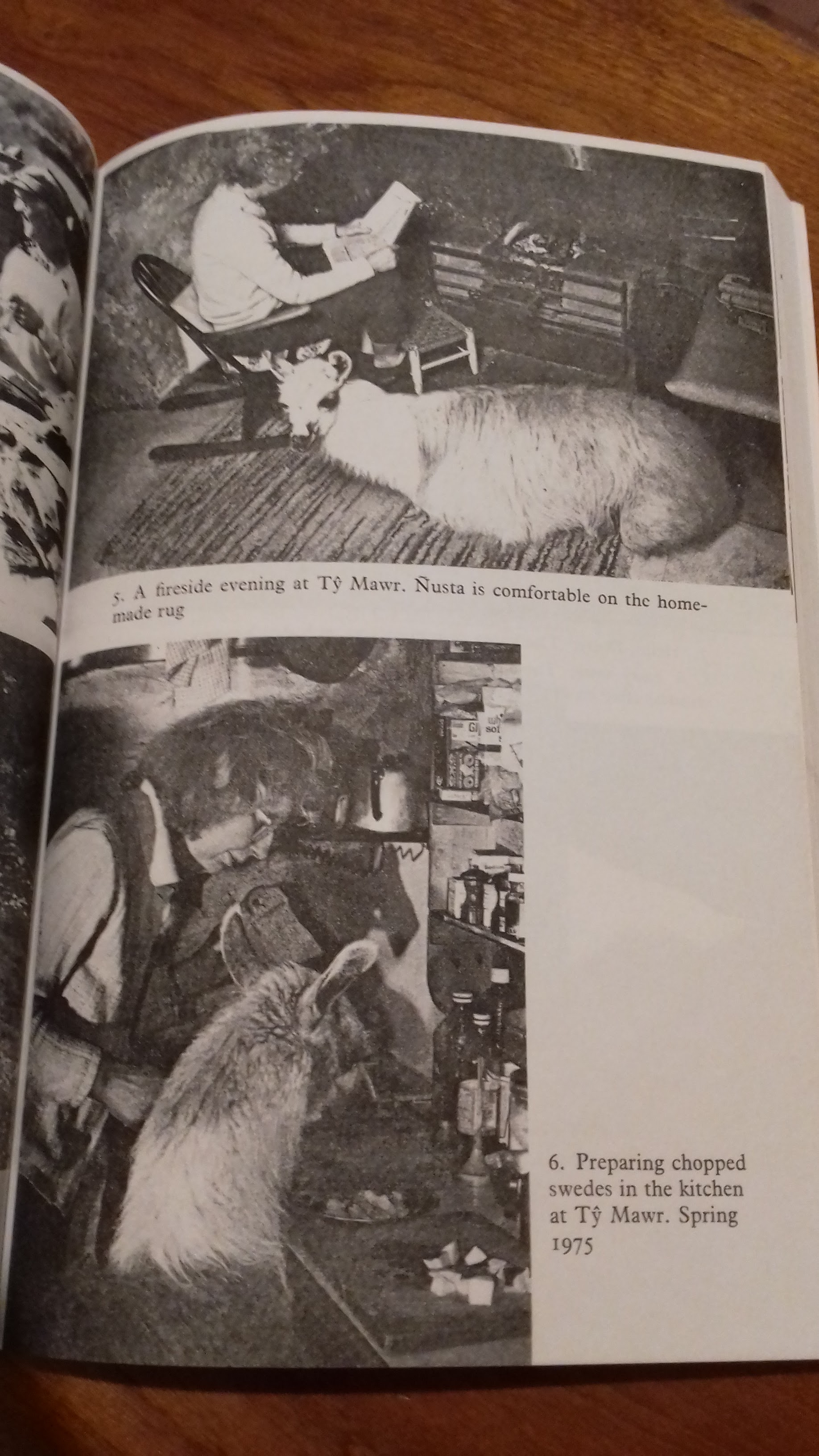
 In my post on 'Along Came a Llama' by Ruth Janette Ruck I mentioned that my edition did not contain any pictures. Reader Pippa was kind enough to send me photo's of her book and here they are: 


Monday, 16 January 2023

Two years of blogging

 I have been blogging for two years now and so far I have reread my way through most of the books on my shelves. There are a few left, most of which are obviously the ones I am not very keen on. We'll see: will I get round to them or will I indulge in some book buying? After all, I have dozens of new (to me) titles to choose from, thanks to all your comments and emails.

Recently I took a look at the statistics to see which posts are the most popular. Much to my surprise the most read post is the one on My New Forest Home by Irene Soper, a book that, until last year, was unknown to me. Other popular posts are on Copsford by J.C.Murray and, of course, on two of the Elizabeth West books.

This year I plan to feature a few unusual books in this genre, such as The Farm in the Green Mountains by Alice Herdan-Zuckmayer (German refugees take up farming in Vermont in the 1940's) and No Matter How Many Skies Have Fallen by Ken Worpole (about Frating Hall Farm, set up in 1943, which provided a settlement and livelihood for individuals and families and a temporary sanctuary for refugees and prisoners-of-war). I also hope to receive information on the life of Dorothy Campion (author of Take Not Our Mountain).


Monday, 9 January 2023

Too many books!

 I buy mainly secondhand books, and since they are so cheap, I'm often tempted. If I don't read them right away, they usually end up on one of a few shelves, and there they will staaayyyy ...  Recently there was an article in a Dutch newpaper about this phenomenon and I thought it was time to do something. So, for the time being: no more reserving books in the public library and no more ordering e-books. I will be working my way through these books and will decide if they will earn a place on my regular shelves or if they will have to go. Here a some titles you may find interesting (I will of course also be reading "farming" books for this blog).

Indian Summer by Alex von Tunzelmann ('The Secret History of the End of an Empire'). Bought on our last visit to India (a fab trip combining sightseeing and cooking lessons).

Remnants of a Separation by Aanchal Malhotra ('A History of the Partition through Material Memory'). Also bought in India. I really like the idea of this book. The author tells the stories of people affected by partition and the (often very few) objects they were able to take with them, such as a bag, kitchenware or a shawl.

War Gardens by Lalage Snow ('A journey Through Conflict in Search of Calm'). I read about this book of gardening against the odds in places like South Sudan and the West Bank and ordered it immediately. When it arrived I was disappointed as I was expecting pictures and the book is mainly text.

Prairie Fires by Caroline Fraser ('The American dreams of Laura Ingalls Wilder'). I started reading this, then got sidetracked. Will start again, I'm sure I will find it fascinating.

Himalaya, a Human History by Ed Douglas. So full of information I will probably not read this in one go. It will find a place with my books on India and Nepal (countries I have visited many times).

The Glass Castle by Jeannette Walls. I started to read it and by the first line knew I had read it before. I read it again, it is a marvelous book. "A remarkable memoir of resilience and redemption, and a revelatory look into a family at once deeply dysfunctional and uniquely vibrant,"

Love in the Blitz by Eileen Alexander. Read several recommendations, so I bought it, but I got stuck on page 30. Will try again.

Do you have unread book piles or shelves?


Wednesday, 30 November 2022

Island on the Edge: a Life on Soay by Anne Cholawo


As described above Anne buys a house on Soay (which was where Lilian Beckwith lived) on a whim, having little idea what she is putting herself in for. When she was seven she wrote an essay which began: 'When I grow up I want to live in the middle of nowhere". Well, this is it. Having little idea of what she is going to live on (apart from some savings), she sells her house and moves north. As she says in a newspaper interview : "I was naive: I thought I would come here, live in a lovely little cottage, look at the view, paint pictures, sell them, and just enjoy the ambience of the place. I didn’t really understand anything at all"

Kind people help her move her stuff to the island and introduce her to how things work (the mailboat, which also carries all supplies she has to order, only calls once a month). It is not the first time she has to depend on the kindness of strangers. Prime example of course is Robert Cholawo, who succeeds in having a navy helicopter move her piano to the island. She later marries Robert.

I liked the first chapters of the book best: Anne describes how she sets up home and gets to know the island and the people who live there, among them the couple Tex and Jeanne Geddes (Tex was Gavin Maxwell's partner in his shark oil factory, which he set up in the late 1940's). She often goes out fishing with Tex. Anne's house has no electricity, water comes from a well.


Anne and Robert organize an exhibition on the island of Muck, to which both contribute paintings. Selling some of them brings in some money as does selling winkles which she picks on the shore. She becomes more involved in island life, helping Jeanne and Tex round up sheep and assisting with slaughter and butchering. I was very surprised to read that she had not had one thought about being self-sufficient (well, she did say she was naive ... ) and only starts growing vegetables because her neighbours convince her to. To her suprise this is a success.


Over the years she adjusts to living on the island and to looking after herself. I would have loved more details on day to day living and a map of the house and the island. Instead, a  large part of the book is devoted to stories about the boats she uses, which I must confess I did not find very interesting.


When Anne comes to live on the island there are 17 inhabitants. From the early nineties the population starts to decline and when she writes the book there are only three people living there. A recurring theme in the books in this blog: living this way is hard work. "People often ask us how we fill our time. Unless you actually live on Soay it is impossible to understand what is required to maintain a decent and comfortable lifestyle on an under-developed island. It's a bit like constantly spinning plates on poles. You have to run from one to another to keep them going before they fall off. " But: "Today, as I write this on a cold, blustery evening sitting by the wood-burning stove, I think of how priviliged, blessed and lucky we have been to have had the chance to live out so much of out lives on such a magical and peaceful island. Even if it had to end tomorrow, we could not have asked for more."

Here is a very nice podcast where you can listen to Anne. This dates from 2021, so it would seem she and Robert are still on the island.


Friday, 18 November 2022

A little more on A Patch in the Forest by Elizabeth West

Blogreader Philippa tells me that she was able to find a copy of Elizabeth West's 'A Patch in the Forest' for £4 in Hay on Wye! Lucky her!

She also shared some information on the location of the house Elizabeth and Alan lived in:

I think that the house Elizabeth describes was in the Parkend area - the drawing of the church in the final chapter is unmistakeably St Paul's at Parkend, it is one of three churches in the Forest that are old enough to match her description - and the only one that has no stained glass and is surrounded by trees.  She mentions the local silver band being formed in 1893, and while Parkend Silver Band folded in the mid 20th century, it was then restarted a few years later and would have been active while she was writing the book.  I'm not aware of any other Silver Band in the Forest that started at the right time and was still active when the book was published.  Also, the tourist attractions she mentions in her book - Clearwell, Puzzle Wood, Mallards Pike, Soudley etc. form a circle with Parkend at the centre.  Of course, it is not possible to narrow down the house any further, but I thought you might be interested at least to know the name of the church. I certainly was!


Drawing of the church


Photo of the church


Tuesday, 25 October 2022

A Fenland Smallholding by Pam Bowers, with illustrations by Pete Westcott (1986)


"This is the story of small beginnings; how a family started with nothing and worked up to seven acres. It tells of all the mistakes we made along the way; and rather than being a "how-to-do-it", a more apt title would have been "How not to be a smallholder."" Pam and Rick Bowers certainly made a mistake buying Ivy Cottage (with one acre of land and three glasshouses) near Wisbech, Cambridgeshire, without taking expert advice. The house needs so much repair that, in Pam's words "just the walls and window frames were to remain". Fortunately, they qualify for a council grant.

At Ivy Cottage "we did all the things we had moved into the country to do, with such serious dedication that it amounted to near fanaticism; we bought the chickens and the goat; we worked the land and reaped the harvest, storing it as housewives of bygone days always did." They also grow strawberries, while husband Rick finds work to supplement their income. I always find it fascinating when writers include lists of their expenditure. Here's Pam's (from 1975):

After five years they move to Fir Tree Cottage in Lincolnshire, which comes with 7 acres of land. "This time round we had more idea of what to look for when buying an old property".


When they move to Ivy cottage they have one son, Jade. They later have three more children: Dicken, Clyde and Bryony. Pam does not give us much domestic detail, nor does she tell us much about family life; instead she concentrates on all the activities on the farm and readers can certainly learn from their experiences and mistakes. There are chapters on growing strawberries and flowers, picking fruit, making cheese, making hay, keeping chickens, goats, rabbits, pigs, bees, sheep, cows, geese and turkeys. Pam becomes interested in dying the wool from their sheep with vegetable dye and she explains the process and includes a list of plants to use. Still needing extra income they install and fit out a caravan, which they rent out to holiday makers.


 They suffer draughts, blizzards, heatwaves and very cold winters but even with setbacks there is no place they would rather be: the last chapter is titled: "But there is nothing else we would rather do".


After all these years the farm is still going strong. "Strawberry Fields", as it is now called, is run by Pam and her children. They now specialise in growing vegetables. Listen to their story on On Your Farm

Pam can be followed on Twitter at https://twitter.com/Organic_pam

Sunday, 18 September 2022

Take Not Our Mountain by Dorothy Campion (1957)


The book starts with this quote, and you know hard times are to come.

This is the story of Dorothy and Whay Campion and their life at Nyth Bran, near Capel Curig in Wales. Whay has lived there for six years, "rebuilding his health and his nerves". Coming from a privileged background Dorothy needs time to get used to life in the hills, in a house with no running water or electricity. Her first winter is a very cold one. At first they only keep sheep. Though the fox kills a number of lambs their first lambing season is successful and they make a profit.

During the following years they slowly expand their flock, keep chickens and pigs and start plowing the land to grow crops.  Life on the farm is tough and they have a hard time getting by. But fate deals them more blows: when Dorothy is on her own the roof catches fire and the house can only just be saved. Worse still, Dorothy is hit by a falling tree and her injuries mean she cannot have children. Some time later they decide to adopt, and a baby boy, Robert, enters their life. Strangely, they decide to pretend Robert is their own baby and Dorothy even goes so far as to wear a pillow under her clothes to pretend she is pregnant. The story then takes a very strange and sad turn: an anonymous letter to the authorities about Whay's past illness sets wheels in motion and Robert is taken way from them.

This book is unique in my collection because it deals with the author's personal life, her feelings of guilt at not being able to have children and the couple's sadness at losing their adopted boy. Dorothy is very much in awe of "her man" but she also stands up for herself and, perhaps unusually for the fifties, makes Whay and herself talk about little Robert to deal with their grief.


The book ends on a positive note: "So we renewed out hope in life and in ourselves and out future plans. Next year we would clear a further six acres adjoining the three we had already ploughed. We would sow another crop of rape. Rape would be followed by rye grass, rye grass would make hay. Eventually we would try to run a few cattle on the land."

"The heartaches and the happinesses have given us all we could ask, and our land will live for others when we are gone. I'm proud to have been able to share your life, your work, your sheep and your lovely green mountain. Thanks so much, Whay".


As far as I know Dorothy wrote two further books: The Perfect Team (1959, about police dogs), and 1,000 Feet Up (1955, selling for 342 pounds on Abebooks!)


In the late nineties, on a visit to Wales I went to Capel Curig and found Nyth Bran (it is marked on Ordnance Survey maps). The house was surrounded by trees, bracken and a barbed wire fence and looked very dilapidated. I could not get very close to take a better photo.


Tuesday, 30 August 2022

The Island House by Mary Considine (2022)

While travelling in southwest England in June I naturally visited every bookshop I saw. As I did not have room in my luggage for many books I made a note of possible titles for the blog, planning to order them once I returned home. But leafing through this book I suddenly read: "The Atkins sisters" and realized it was a book about their island. Of course I just had to buy it at once. 

As a child Mary Considine, with her family, spent many summers on Looe island, then owned by Evelyn (known as Attie) and Babs Atkins. Later she becomes part of their "shifting army of helpers". Having only read Evelyn's description of life on the island I found it interesting to read about Mary's experiences. It sounds like Babs and Evelyn weren't the easiest people to get along with. They fiercely guarded their privacy and discouraged any visitors to their home: "The sisters, in their fortress, were all-powerfull, fascinating, alarming. Attie, the elder sister, and author of bestseller We Bought an Island - signed copies available in the craft shop - was larger than Babs, more aloof, increasingly only sporadically involved in wider island life. They sported matching grey perms and glasses, but Attie's shrewd eyes were magnified behind thicker lenses, and her mood was always unpredictable. Babs, ten years younger, and not long retired from her teaching career, seemed to us the practical one, who handled bookings for helpers and holidaymakers and met everyone who set foot here. Attie, the nickname from her wartime stint in the WRNS, had been the driving force behind their move to the island in the sixties: ten or twenty or thirty years later, she still wielded powerful charm and was given to expansive passions." When Mary's mother, a well-regarded poet with many publications and prizes to her name, produced a book of island-based poems, dedicated to the sisters, they maintained a stony silence until she finally asked what they thought. "Not a very happy choice, was the frosty response. There was only space for one writer on the island".

Years later Mary and her partner Patrick live in London. They buy a cottage in Looe, the same house the Atkins sisters first bought when they came to Cornwall. After a difficult time with infertility treatment, IVF and Mary's father's illness and death they feel a need to commit to Cornwall full-time (Patrick can work from home). They apply to "island sit"while the regular wardens go on holiday, and they get the job. They love it and the Cornwall Wildlife Trust allows them to live permanently in Island House. This is five years after Babs' death. The plan is "for us to renovate the house, sympathetically (it is unlisted) and with as much use of "green" technology as possible, in return for a long lease. (...) I kept wondering what Babs and Attie would have thought: of their house being lived in by other people, of those other people being me and my husband. I wondered if Babs would haunt me."

Mary and Patrick move to the island and start on the renovations. With the weather being very unpredictable, transport to the the island proves difficult. They employ builders and also get a lot of help from family and friends. They keep pigs, chickens and bees and have a fairly successful vegetable patch. Mary dreams of flowers and buys lots of plants. "The trembling plants are doomed by my relentless optimism, by the gleeful snails, and most of all by the wind, careering in from the south-east with salt in its mouth to burn and wither almost everything I plant."

They don't seem to get on with boats and machinery. When they try out their first boat the engine fails and they only just manage to return to the island. Other boats don't last long and the range cooker, generator, wind turbine and quad bike all give them endless trouble.


After their first winter, they settle "into the good life, chipping away at painting the outside walls (...), fine-tuning the electrical and water systems, scrubbing old slate floors and making endless fixes to the house. Patrick and Justin's (Patricks business partner) business is still in its infancy and money is tight, but we're not worried yet. We are content with each other, our dog and cats, the sound of the gulls and the light on the water". Actually, I could not really tell if Mary was really happy on the island, living there seemed to come with a lot of stress.

After a few years Patrick (who is profoundly deaf and gets help from "hearing dog" Skip) develops health problems and for a while Mary is in and out of hospital. They realize they will have to leave the island. After a final Christmas party and a final summer they move to Devon, having spent 6,5 years on the island.

Mary has a tendency to jump from past to present and back again in her story, while mixing present and past tenses. This made for confusing reading. I wanted so much to like this book and found that I did not, I got stuck half way and had to force myself to finish it. I don't really know why. Evelyn's books seem to have been written as one long chat and could have done with some editing. Yet I found them fascinating. Mary probably put a lot of thought into her book and had the help of experts, and I find her book boring. If you have read the book, please let me know what you think.


My posts about Evelyn's books can be found here  and here