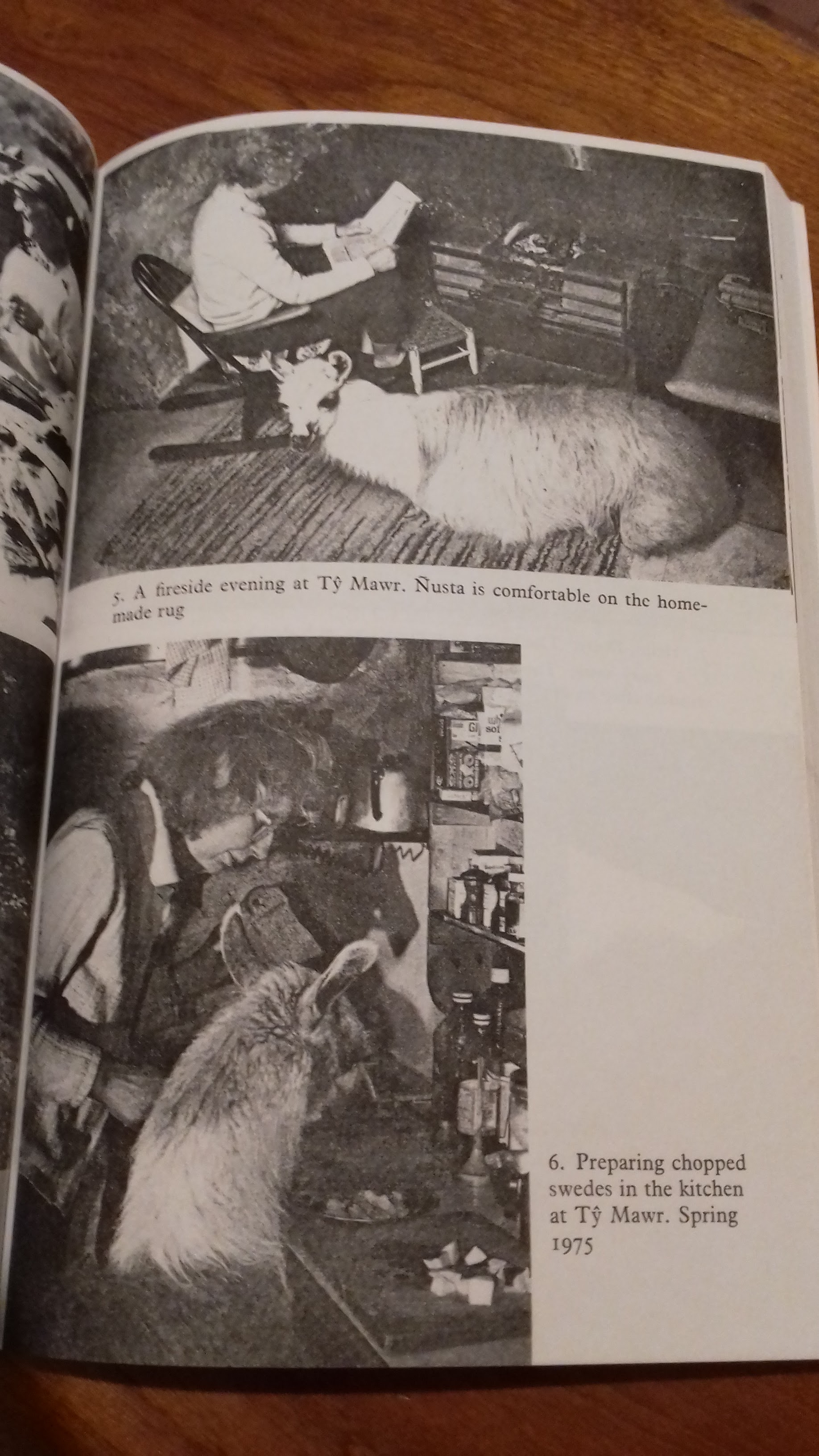
In my post on 'Along Came a Llama' by Ruth Janette Ruck I mentioned that my edition did not contain any pictures. Reader Pippa was kind enough to send me photo's of her book and here they are:


A blog about books by people who got away from it all. My aim is to find out more about the authors and to discover new titles. I would love to hear from people who share my love of this genre. Contact me, Miki, at farmsonmybookshelfATgmail.com
In my post on 'Along Came a Llama' by Ruth Janette Ruck I mentioned that my edition did not contain any pictures. Reader Pippa was kind enough to send me photo's of her book and here they are:
Re-reading Along Came a Llama, I came across a passage in particular in this book that I liked, and it has nothing to
do with llama's. I recently came across a new Dutch word coined by a writer :
"eetlezen", literally "eat-reading", i.e. reading while you eat, which
is one of my favourite passtimes. Ruth and her family like it too:
"Reading was our main relaxation, hobby and perhaps vice. Paul, Beenie and I would read our way through most meals with our books balanced against the Golden Syrup or milk jug. Of course we did not read when we had visitors or at Saturday and Sunday dinner when the children were at home, or indeed in the school holidays. We felt that we should be setting such an appalling example and anyway, with five of us reading at the table, somebody's book or magazine would be sure to find it's way into the butter or the gravy. We confined our reading at meals to the times when there were just the three of us. There wasn't much point in keeping mealtimes for conversation. Mostly we had been working together all day and had had plenty of opportunity to say all we wanted to say."
I do like this. Sunday evening is my "eat-read" night as H. watches Studio Sport (Dutch equivalent of Match of the Day) and I read.
Anyway, llama's!

This is Ruth Janette Ruck's third and final book. Although there is a sad beginning there is plenty to smile at in this book. In the 1960's Ruth and her husband Paul move to the cottage of Ty Mawr, a few hundred yards from Carneddi, where her parents and sister Mary (who is very ill) live. In 1966 their daughter Ann is born, followed by a son, John, in 1968. Soon after, Ruth is diagnosed with Multiple sclerosis. "Soon I decided that it was better to do something useful and feel ill than to nothing and still feel ill. Then, mercifully, I became much better and most of the sight returned to the affected eye (she had become blind in one eye). It was the beginning of a remission that lasted for a couple of years. There were to be other exacerbations but I did my best not to let them affect our lives and we all carried on as well as we could". Little mention is made of MS in the rest of the book.
Paul's sister Jean, known as Beenie, comes to live with them and proves to be a big help. During a short holiday the family visit Knaresborough Zoo, where they get to know a group of llamas.
As a child, Ruth wrote in her notebook "I want a llama" and she suddenly has the feeling that they will have one on their farm. After her father dies suddenly, her mother offers to pay for a llama, feeling they need something new and exciting to distract their minds from their father's death and Mary's illness. After another visit to the zoo the deal is struck and some time later 5 month old Annie, as she is called then, arrives in Wales.

In 1975 Ruth's sister Mary, who had been ill so long, dies. "Now my mother demonstrated to us that life must go on whatever sorrows there were. She set to work to rehabilitate her garden which had long been neglected. She had more time for her grandchildren. She took a renewed interest in the farm and pleasure in the llama. We all drew inspiration from her courage and unbreakable spirit."
The llama becomes a much loved pet, who seems to see the family as her herd. As this was a time when llama's were seldom seen in the British countryside many people are baffled when they see her. Nusta is always interested in visitors: "If she were near at hand she would hurry up to inspect them. This inspection was a sort of llama-style interview. She liked to look closely into the face of each person - and her head was now nearly on the level of most humans' - and to touch their hair lightly with her nose. Beards were also of great interest."
Finding information on how best to care for llamas is hard. Books on the subject are rare, and vets are not very familiar with the animal. "Our best authority so far was still Goldsmith's Animated Nature, published two hundred years earlier and written by a man who had, perhaps, never seen an llama."

Ñusta can roam freely around the farm. "During the day she was busy about the farm, taking a llama's eye-view of all the activities and joining in whenever she could. (...) She was aware of the sound of the engine before anyone else could hear it. As I drove up the hill, I could usually see a small white face with dark eyes and long ears peeping inquiringly over the five-foot wall which ran along the crest of the spur. After a long look, the face would disappear and I knew that the Um was rushing along on the other side of the wall, to reach the yard gate at the same time that I did. When I stopped by the garage, a head and a very long neck would come in through the car window and the llama would toot an excited welcome."
The book ends with their decision to have Ñusta mated. For this they travel to Chester Zoo, where there is a small herd of llamas. And strangely this is were Ruth ends this very entertaining and well written tale: we don't know if Ñusta gets pregnant or what happens next.
My edition of this book is a 2020 reprint. Though Ruth thanks someone in the acknowledgements for preparing the photographs, there are none in the book (apart from a vague one on the back flap).

I was surprised to find that this book was recently published in Dutch (as was a translation of Copsford).


In the first chapter Ruth looks back on how she and her family started farming at Carneddi, copying other farmers’ work and relying on the help of two neighbours. One „took us under his wing and we were immensely grateful for the never-failing help and kindness which he gave. If he thought we were going wrong, he told us so: he hated to see mistakes and muddle, particularly where sheep were concerned. If we needed anything, from advice to a cup of tea or the loan of a plough, it was ours for the asking”.
She also tells the story of how she came to write her first book, filling exercise books when she can find the time. It takes nearly 3 years to finish. She is overjoyed to find it accepted by a publisher. After starting her second book their hen house is made into a writing hut.
She goes on to describe the day to day life on the farm: the sheep, the dogs, the decision to keep ponies and to enter them in shows; and the joy Paul and Ruth find in mountain climbing.
They extend the farm by buying neighbouring farms and stock.

During the first months of 1963 the weather turns extremely cold: "Washing froze stiff as a board within five minutes of its being hung on the line. The last of the kale in the field turned to green glass and shattered into fragments when we tried to cut it. The tap in the cowshed froze but we had given up swilling the floor several day earlier for fear of the cows slipping on the ice. I carried hatching eggs indoors in case they should freeze too.”
I was ten years old in 1963 and in The Netherlands the weather was similarly cold. Strangely I have no recollection of it, though our house must have been extremely cold as at that time we only had a heater in the living room. 1963 is also the winter that Dervla Murphy, one of my favourite authors, started her cycling trip to India. You can find the story in Full Tilt. I always wondered why she started her journey then, only to arrive in Pakistan and India in the extreme summer heat. She later said she had so often fantasized about this trip, that when she got her chance, she just could not wait.
Anyway, back to Ruth: she ends the book with a postscript: „It should be told because it gave a new perspective to our life. In the early summer of 1965 I began to wonder if I were pregnant”. She is, and Ann Jacquetta is born on 14 January. „ I look back on that time as one of the happiest of my life. (…) On January 24th, the day on which our baby was due to be born, we brought her home to the cottage in the mountains.

"I think it was mother who first suggested that we bought Carneddi. The thread of out normal existence seemed to have been broken by the end of the war, which made my father’s work redundant, and by my sudden illness. A moment of pause and choice had come to us. (…) At first the idea of farming in the hills seemed quite impracticable. My father was fifty, I was seventeen and we had lived in the city all our lives. It was true that Carneddi was to be sold cheaply, but even so we had little money to cover any mistakes we might make. Yet somehow we were unwilling to settle back into a suburban routine once more. We talked, wondered, and at last decided. We bought the farm, and burned the boats of the life we had always known."
They move to the farm in 1946. With the farm they acquire sheep, cows and a sheepdog. Their neighbours (whose first language is Welsh) are very helpful. At first their policy was "to farm as it had been farmed in the past". Ruth reads all she can find on farming and is especially encouraged by The Farming Ladder by George Henderson.
They watch other people’s farming activities with an eager eye, and copy them.
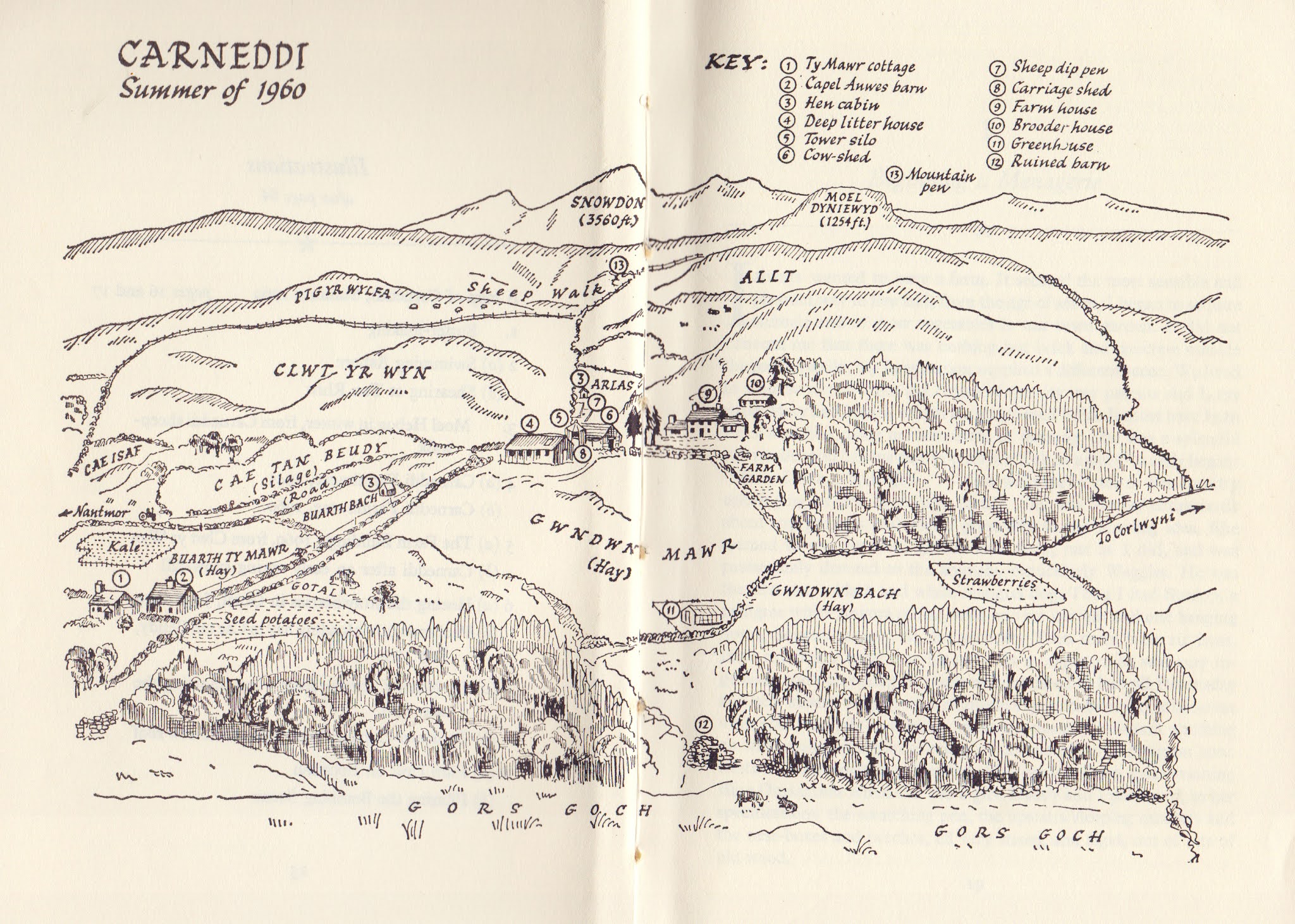
The farm comes with a small mountain flock of sheep and they find a shepherd, Tom, to help them with it. They make improvements to the house and buy a cart horse.
To learn more. Ruth goes to work on a farm but returns when she realizes her family cannot manage without her. To make the business pay they need to farm more intensively. I wonder it Ruth had any idea what „ intensive farming” would come to mean a few decades later . . .
She starts by keeping more chickens and taking part in a government scheme that means she receives food coupons for chicken feed.
The few cows they keep provide them with enough milk for their own use. I presume they grew their own vegetables but no mention is made of this.
Ruth thinks women do not make good employers. "By nature they prefer to follow rather than to lead and the thought of employing a man can be a horrifying one.” Nevertheless she employs Paul, to help her with improvements, partly subsidized by the Hill Farming Act.

Paul is an experienced climber and together with friends he and Ruth make many trips into the hills. Although initially apprehensive, she later begins to relish climbing
After 5 years at Carneddi Fred leaves for Australia; Ruth gets the chance to work at George Henderson’s farm.
Back home again she builds a new shed for the chickens. With an asbestos roof!
Later she keeps turkeys. She also joins a successful scheme for growing strawberry plants in isolated place to keep them far away from aphides.
She manages to rent a cottage (Ty Mawr), does it up and rents it to tourists.
The book ends with the story of how Ruth spends summer months working for a film crew, filming The Inn of Sixth Happiness.

In the first chapter Ruth says: „We had little money to cover any mistakes we might make.”
This makes it even harder to understand what the family lived on, especially during the first few years, when sheep die and chickens are killed by foxes. During this time Ruth spends long periods away from the farm (studying and working on another farm) and her parents are not able to manage on their own.
And then there is „nanny” Fred, who, presumably, they pay. They also employ people to work on the farm.
The family start out as amateurs, but Ruth becomes a real farmer. It is interesting to read how you could apparently make a living from such small scale farming in the 40’s and 50’s.
To the 21st century reader, the enthusiastic use of insecticides and asbestos is startling.
I like this book because of the combination of the personal and the practical. It can be read as a handbook for hill farming, but it is also Ruth’s autobiography.
Ruth went on to write two more books, which I will cover in later posts.

