Showing posts with label Helen Hoover. Show all posts

Friday, 10 April 2026

Her Place in the Woods : the Life of Helen Hoover by David Hakensen


Every year or so I search the internet to see if any new publications have come up on 'my' authors. Which is how I discovered this biography.

Helen Hoover (1910 - 1984) was born in Greenfield, Ohio. After a pampered childhood her life changed abruptly after her father died, leaving her and her mother with no money. Together they move to Chicago where Helen finds a job. She meets Adrian Hover on a double date. It is Adrian who comes up with the idea of "'living in the woods for a while'. They marry in 1937. This is when Helen starts writing, selling her first piece to a newspaper. Slowly their life improves, they can afford a car, a camera and take holidays. By the summer of 1939 they are at last ready to begin their search for the idyllic cabin in the forest. But after Japan's attack on Pearl Harbour it becomes clear that Adrian will be called up, while Helen sees more opportunities opening for women.


It will take them until the late 1940's to discover their ideal spot at Gunflint Lake. They buy a derelict cabin, and later purchase a second one on a neighbouring plot, and in 1954 they leave their jobs to live there permanently. Moving in in the autumn makes it extra hard: most neighbours who could help them have left by now,  and they are not really prepared for the severely cold winter. While getting supplies in from town they have a car accident, leaving them carless and jobless (Adrian was to have met a contact for a lucrative job). 
What will they live on? Slowly, Helen begins to sell stories to magazines, while Adrian designs and sells notepaper. They still struggle to make ends meet. Apart from food for themselves they also buy food for the animals they feed in winter, at considerable expense. During the winter their diet is so poorly balanced that Helen develops scurvy and anemia. For the whole story see this post. 
By the late 1950's Helen's writing is bringing in more money and she is contemplating writing a book.


Her first book, The Long-Shadowed Forest, is published in 1963. This is a book about the animals she encountered. More books on animals follow. Is is not until 1969 that she writes her book on her and Adrian's life in the forest: A Place in the Woods. The books are beautifully illustrated by Adrian.
While the books are succesful they also cause a stream of visitors, interrupting their paradise and longing for peace and quiet. In the end they decide to leave. They spend time in Florida and New Mexico (where they get into trouble with the authorities for feeding and thus attracting stray cats), before ending up in Wyoming. There, their growing cat colony again becomes a problem.
The Years of the Forest, Helen's second book on her life in the forest, is published in 1973. 
Read my post on this book here.
Helen and Adrian valued their privacy greatly. Once they move to their final house in Laramie they rarely left home.

Helen died in 1984, Adrian in 1986.


While I was glad to discover more about Helen Hoover I found this a disappointing biography.  Although in the acknowledgements David Hakensen mentions talking to people around Gunflint Lake  there is little evidence of this in the book. In her letters HH complained about being obstructed by locals. Was this true or just her imagination? I wish David H would have given us some more quotes from people who lived at Gunflint Lake at the time.  
It would at least have made the book more lively, as now it reads more like a report of everything David H. found in HH's lettters. This means we learn, in extreme detail, about her correspondence with her agents and publishers. While David H. tells us what HH wrote in her letters, he rarely quotes from them. I wish he had, because I love HH's writing in her books and would be very interested to read her letters (I wonder if anyone has thought of publishing them?).
The other thing I find odd about this book is that David H. seems to pay more attention to Helen's relationship with her agent and publishers than to her relationship with her husband or his work as an artist. 

The book left me feeling sad for Helen, who according to David H. struggled with her mental and physical health, searching for the ideal place to live but somehow never finding it, or only for a short time.


Sunday, 19 September 2021

The Forest Years by Helen Hoover, with pen-and-ink drawings by Adrian Hoover (1973)

This book was published five years after "A Place in the Woods" and it covers the 16 years Helen and Adrian Hoover spent in their cabin on Gunflint Lake, on the Canadian border in Minnesota. While the text on the book flap states that they spent those years happily and rewardingly this was not alway so and the book ends with their leaving the area.

On the one hand this is the story of how Helen and Adrian make the cabin their home and how they cope with living in northern Minnesota, with its harsh climate. On the other it is a record of the nature that surrounds them and the animals that come to visit.

As we learned in Helen's earlier book, living in the woods in hard work. Even in spring or summer things don't get much easier: "the mosquitos and black flies were out in full force, ready for their coming task of fertilizing the flowers, and they bit so ferociously that we gave up on outdoor work." They don't hunt or fish and the very short summer season makes it very difficult to grow vegetables. They do keep a few chickens (in a heated run in winter). But mostly they depend on mail order and deliveries of food and oil. Missing an oil truck delivery, or being snowed in with little food, are potential disasters. Their first years in the cabin are very hard, as they struggle to pay their bills. They earn just enough money selling notepaper printed with Adrian's designs and they live on such an unbalanced diet that at one time Helen even suffers from scurvy. 


 "Ade and I had come to the forest believing that we would have to work harder than we had ever worked and thinking the depression years had prepared us, but we discovered they had been relatively easy. We had been poor in the sense of having to cut corners during our first year and a half in the woods. Two years later we were poverty stricken - cold, hungry, ragged, sick and touched by flashes of paralyzing terror. This was not the fear of death but the fear of living, of never having some small pleasure or physical comfort of a moment free of worry so long as life should last. (...) And yet I warmed to the happy moments we were finding in this innocent forest. The wild creatures were our friends and companions, our teachers, our entertainers ..."

Gradually Helen starts to earn some money when she sells magazine articles and the hard years are over when she gets her first book contract.

"When the book was roughed out, I roamed the forest, burdened with two field guides that I carried around my neck in a two-pound clothespin bag, checking my reported observations for accuracy. (...) When I grew tired I sat at the base of a big pine or spruce, leaned back, and closed my eyes. My skin grew sensitive to the touch of the special air of spring, the drier air of summer. Faint creakings told me of branches rubbing together. One day my nose crinkled to an acrid scent, something like rancid oil, and I opened my eyes to see a black bear strolling toward me. I sat without moving while he came almost to my resting place, observed me with shifting eyes as I was observing him, sniffed and wandered away, presumably no longer curious."

Later in the book there a more encounters with (hungry) bears and one winter things become so dangerous, as bears could easily smash their doors and windows, that they go and spend some time in a motel.

While they still encounter a lot of kindness, they are also seen as weirdos, living without a car and refusing to have a power line put in (because it would mean cutting down lots of trees). They also refuse to cut down trees or use DDT during an infestion of budworms that takes a few years. In the end their policy of letting nature take care of itself pays off. 

A lot of animals, especially deer, come to the cabin in winter, in search of food.  They order food for animals but word gets round and this attract hunters, and some of the deer that have been visiting them for years are killed.

With the extra money they earn they do up their cabin and they can afford a few more luxuries, but things start to change: the road is repaired, more tourists come, the solitude they cherished is gone and they begin to feel uncomfortable where once they were so happy.

"Power, phone and road together attracted more and more people, which meant more and more building. This necessitated clearing, which increased run-off water and silting of the lakes, and the installation of many cesspools that released an effluent that stimulated algae growth in the clear water, as the privies of the old days had not done. More planes and boats to accommodate the larger number of people added their oil films to the lake."  

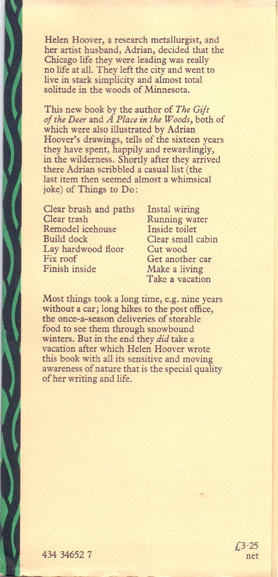
In the end they take a vacation, the last item on their list (see book flap below), and start looking for another place to live.


If you would like to read more about Helen Hoover, a very good article by David Hakensen can be found here

Thursday, 26 August 2021

A Place in the Woods by Helen Hoover, illustrated by Adrian Hoover (1968)

After Adrian Hoover becomes ill he and Helen spend two months in northern Minnesota, but when the time comes to go home they decide to stay (this is in 1954). In Chicago Adrian worked as an art director of a publishing firm, and Helen was a research metallurgist in a laboratory.

Someone later tells Helen: ". . . but you might as well know that some people up here have been betting - really betting, I mean - that you won't stay the winter"

This is hardly surprising. While Adrian is the ultimate handyman, and it seems they have visited this area before, both Helen and he are strangely naive about living there. For instance, it seems it has not occurred to them that they might need warm clothes in winter.  Helen also hadn't realised she does not need a fridge or freezer: Adrian sat down and laughed till he choked. Finally: "How were you ever so good in science? Look:"He waved a hand at the window. "Out there everything is frozen and will stay that way, in the shade at least, until spring". I do like Helen for telling us all this.


Their time in the woods starts with a series of mishaps.The first cabin they buy, which is not very well made, is damaged by heavy rain and floods which wash away part of the basement (this coincides with a very scary visit by a bear when Helen is on her own). By one stroke of good luck they find someone to make repairs, and by another the neighbouring cabin is for sale. This looks much nicer, plus it comes with lots of furniture that they like. But there is one thing they haven't taken into account: this cabin is only built for summer use. So it is back to the first cabin again for winter, and they head into town (a three hour drive in good conditions) to buy provisions, warm winter clothes and to collect their mail order purchases, which include two stoves. On the way back to the cabin, they collide with another car. Running out of money, recovering from the accident and stuck in the cabin without a car, Adrian misses an appointment to sign a contract which could have earned him a lot of money. But as Helen says: "if he had been there on time to sign the contract we'd have had an easy life and another car. And it is very possible that I should never have written anything except letters to my friends". 


They adapt to life in the cabin, getting to know the land and the animals that live there. One morning Adrian calls Helen to come outside. "Frost, he said in an awestruck voice. "It's frost".  I've always thought of frost as something white sprinkled on grass like sugar, but this was a feathery miracle. Every twig was fringed by it, every branch festooned, every bud tufted. Delicate ice plumes hung inches long from our eaves. The windows were barley sugar and the cabin logs were netted over by tiny ice fans.


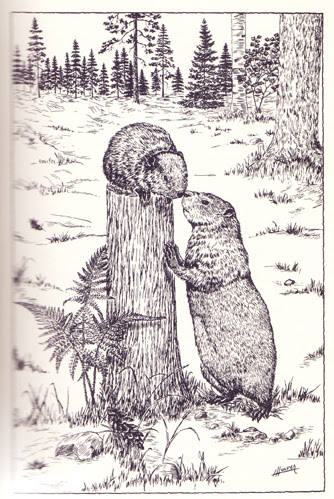
The snow stopped before dark, as suddenly as it had begun and Ade and I stepped out to look at the fresh white. The silence was so deep that I could hear my blood throbbing in my ears. The air carried a scent like the taste of snow. A feeling of being watched from the white forest was very strong. "They're all around us", I said. "The natives. We're a minority of two". During the winter they get to know some of those natives, among them mice, deer, birds, squirrels, weasels and an animal I had never heard of: the fisher (see picture below).

They need to find a way of making money and buy a mimeograph, which they use to produce note paper decorated by Adrian. This sells well. He also manages to sell woodwork. Another small source of income is taking care of a rain gauge for the US Weather Bureau. By the end of the book Helen has sold a few articles to magazines.

During the winter Adrian reads from David Copperfield while Helen crochets or embroiders. Copperfield was a fortunate selection because from it came the motto that for several years was tacked onto a log in the kitchen: SOMETHING WILL TURN UP.  J.Wilkins Micawber.


The winter passes. Helen looses track of time and is astonished it already is 19 February. I looked up and across the lake to the clear blue above the far hills and thought about my disorted time sense that seemd to have lost me three weeks. But it wasn't really distorted and I hadn't lost anything. I'd just been seeing things in a way that was new and different to me, a way that I'd probably known in early childhood and forgotten.

They are happy with what litle they have.

A Chicago friend wanted to know when we were coming back to civilazation. I looked out of the window and up through the bare lacework of a birch top to the blue, blue sky. I smelled the faint fragrance of balsam smoke from the stove. I listened to the querulous piping of some nuthatches. I thought of the woodpiles and my white ceiling and the stored groceries - all of the fall work behind and the winter chores ahead. Of the dim, tantalizing glimpses of possible independent careers. Civilization? We were as civilized in our forest setting as my friend was in het concrete beehive, but it would be useless to try to tell her so.

I could quote from this book endlessly. A recent acquisition and an instant favourite, it has everything:  domestic and financial detail, hardship, nature, animals, the kindness of strangers and of course a map. Helen wrote 7 books for adults (also some children's books). The Years of the Forest is another book about their cabin life, which I will cover in a future post.