I just found this interesting blog by the people now living in John Seymour's former home in Suffolk. The bloggers, Debbie and Keith, rent from Chillesford Lodge Estate. There are quite a few references to John Semour's legacy and it is interesting reading.

A blog about books by people who got away from it all. My aim is to find out more about the authors and to discover new titles. I would love to hear from people who share my love of this genre. Contact me, Miki, at farmsonmybookshelfATgmail.com
Showing posts with label Suffolk. Show all posts
Showing posts with label Suffolk. Show all posts
Saturday, 28 June 2025
John Seymour's home

Tuesday, 22 February 2022
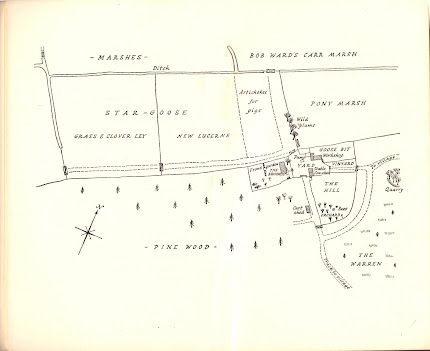
The Fat of the Land by John Seymour, with illustrations by Sally Seymour (1961, my edition from 1974)

'Here we all sit, Sally my wife, Jane who is five and a half, Ann who is two and a half, and Kate who is seven (days), a mile from a hard road, with no electricity, no gas, no deliveries of anything excepting coal, provided we take at least a ton, and mail, and the post woman gets specially paid for coming here. And we are self-supporting for every kind of food excepting tea, coffee, flour, sugar and salt.'
We all know John Seymour as the godfather of a movement but it seems he stumbled upon his calling. After living on a boat John (who works as a writer) and his wife Sally (who is a potter) start looking for a house for their young family. On page 14 he states: 'Certainly we did not want a farm.' They have a hard time finding a place to live but then they are offered a double cottage in a remote location ('The Broom') for very little rent, provided they keep everything in repair. When they move in they have one daughter, a second one is born while they are living there.
It is the remoteness that does it. 'For every single thing we wanted we had to go a mile and a half to the village to buy it. Our milk we arranged to have left every morning at some cottages a mile away from us, and every morning somebody had to go and get this.' So they get a cow (in August 1957) to provide them with milk. 'We were forced into pigs by circumstance of having three or four gallons of milk to dispose of every day.' This was when they had not yet learned how to make butter and cheese. 'And what were we going to do with all that dung? We would have to extend our gardening and farming activities. Brownie forced us, a long way, along the road that we had never planned to travel: the road to self-sufficiency and a peasant economy.'
In his biography on the Seymour family website it says: John Seymour roared through life. This is certainly the feeling you get while reading The Fat of the Land. He displays all the zeal of the newly converted, in his hurry to tell the story he often has to stop and say: but that was later, I'm getting ahead of myself.

John and Sally start growing vegetables and acquire chickens and ducks and plant fruit trees. They are novices at it all: 'We worked ridiculously hard. For not only did we have to do a great number of jobs every day - but we had to learn how to do them. (...) Whether it was planting a fruit tree, sowing some radish seed, wringing a duck's neck, gutting and skinning a rabbit: we practically had to do it with a book in one hand and the thing in the other. This made everything ten times as difficult.'

Though John devotes a chapter to the house (describing the rooms and what they are used for), we get no idea what it was like to live there as a family. After the first few pages the children aren't mentioned in the book.
John and Sally use books at first to find out how to run a smallholding, but a few chapters later John seems to have thrown them out. He does not care for anything"modern" and as for the poor wageslaves who live in modern houses, in villages or towns, they have lost all connection with nature and simply don't realize how badly off they are.
The book is part story, part how-to (it includes an index). John relates all their successes and failures with vegetables, their use of different kinds of wood, the slaughtering of pigs. There is also a large section on thatching and chapters on preserving, wild foods and the use of tools. John also gives an insight into the amount of money they spend and earn (John works as a writer and broadcaster, and Sally sells her pottery).


My edition from 1974 ends with an extra chapter in which John looks back on his time in Suffolk and tells us of his move to Wales. 'When we found ourselves becoming self-sufficient in food at the Broom we were probably the only family in England living this way. Now hundreds are doing it - and tens of thousands who would like to. ' The story of his Welsh farm is told in 'I'm a Stranger Here Myself' (1978).
The Broom is now available for rent as a holiday cottage.
A good source for further reading on John Seymour is his family's website Pantryfields
Monday, 17 January 2022
Apple Acre by Adrian Bell (1942)

Apple Acre is the story of farming and bringing up young children in the dark days at the beginning of the Second World War. " I had come to this village of Gruncham from West Suffolk just before the Nazi War. I had a few acres there, and later in 1943, I acquired more. Our children were infants when the war started, Anthea was three, the twins (Martin and Sylvia) were only one. We were five miles from the nearest town, and had no car nor petrol to get there. There was a bus twice a week. Otherwise we relied on bicycles or a pony trap for our shoppings. We seldom left the village in those years. There were shortages of the necessities of life - of clothes, food, milk, eggs. We were lucky in having our own pig, our own hens. Our staple food was potatoes and bacon. My wife made all the children's clothes from old garment of hers or a store of material we had laid in in August 1939. We had no piped water. Our well ran dry regularly every summer: unless it rained we could not have baths."
This is the story of Adrian's farm, the landscape, the farmers, craftsmen and other people in the village. Or rather, it is not so much a story as a collection of Adrian's thoughts and observations. After reading the book you don't actually know much about his farm, but you do know what it felt like to live there at the beginning of the war. Adrian needs few words to paint a picture.

One day he and his wife Nora buy six goslings who turn out to be voracious creatures. "We referred to a book and read: "Goslings require very little artificial food, as they consume large quantities of grass." I wished these goslings could read. And then one day towards Michaelmas, they happened to be at the far side of the orchard when I went out with their food. They stretched their necks and came full pelt - full waddle, that is - their wings flapping. Suddenly the leading goose became airborne and then the others. Their feet continued paddling the air. My impression was that they were as surprised as I was to find themselves flying. They gathered momentum, overshot the food, gave one despairing honk at it, and sailed out of sight over the hedge." The geese return to the farmer who sold them to Adrian ...
At first the war hardly seems to intrude and life goes on like it always did. The children seem to take the noises they hear (guns and planes) for granted: "It's only an aeroplane," Anthea says, as we look up and see one of England's battle planes sailing over at two or three hundred miles an hour, and she stoops again to make another sand pie. Aeroplanes are not very interesting birds, Anthea thinks. Not as interesting as the blackbird sitting on five eggs in the hedge." But later the threat of invasion becomes more real and Nora and the children spend a year in northern England.
"The war is more than bombs, it is a state of being. I feel it in the furtive quiet of the town. It is the soul of civilization that has fallen, caved in, long-decayed, hollow: and everybody goes furtively, knowing the end has come."
I especially like this book because of the way Adrian Bell writes about his children. He has an eye for their behaviour, an ear for their talk.

"Martin has seen the big mirror. Nora is left playing nursery rhymes to herself. Mirror superseeds music. Martin is stood up in front of it. He looks first at us in the mirror. They are here, yet they are there: what is the solution? His eyes get wider and blacker. Sylvia is held up to it. She quickly takes it for granted that there should be two of everybody. Anyhow, she is not going to worry about it. Grandma swings her to her reflection: she laughs uproariously. Martin is not amused. To be waved at in the mirror makes it the more puzzling. He struts around the room very worriedlooking."

"Filling being put into a new cake. Anthea has got on to a chair to see. 'I want a piece'. Occasionally she tries something quite obviously unpermissible. 'I want a piece now.' 'Whoever heard of such a thing!' It has worked: she begins to chuckle: 'I want a piece now.' Taking off my boots, feeling warm and cheerful beside the chrysanthemums, I begin, 'Do you know, when Father was a little boy - ' That always makes Anthea look. 'Yes?' 'When Father was a little boy he always had to have two slices of bread and butter before he was allowed to have a piece of cake.' 'Yes. And did your mummy make you a chocolate cake, with fillin' in it?' 'No, it was just a plain sponge cake: (I do remember a lot of plain sponge cake) and no filling in it.' 'Yes." A small voice. I look up sharply. The head is lowered, the face red. The thought of Father getting only plain sponge after the dutiful two slices is almost too much. I hasten to add, 'But if he had been a good boy he used to have a chocolate biscuit sometimes." Yes." A whisper. 'But then', crescendo, 'when it was his birthday he used to have a lovely cake, all sugar icing, and Happy Returns of the Day written in pink, and candles -' 'Yes' The head higher. 'And he used to have lots of little boyes to tea with him, and they played all sorts of games.' A smile. 'Why, look at pussy - she's trying to catch her tail.' She is having a whirling fit on the floor. Relief and joy."

Much has been written about Adrian Bell, there is an Adrian Bell Society , but this book seems to be less well known.
The back flap of my 1964 reprint gives an interesting glimpse into how men and women were thought of at that time: The children of whom he writes in Apple Acre have now grown up. Anthea and Sylvia are married and have young children of their own, while Martin is a journalist. Quite.
Anthea became an eminent translator , perhaps best known for her translations of the Asterix comics.
Monday, 5 July 2021
Betty Dougherty: Green Gardener: Creating a Wild Garden (1975)

So far, I have gardened in two small gardens and on one large balcony. I hardly ever consult gardening books or the Internet: I just like to try out things and see how I get on. On the other hand, I love books about how someone made a garden. One of the first „garden stories” I bought is this one. I bought it in 1977, I know that because back then I still made a note of the purchase date and place in my books. At the time I was a student living in a flat and I can’t remember having an interest in gardens. Still, something must have attracted me to the book. Having just reread it I think it must have been the story of the discovery, buying and developing of the house and garden rather than the information on plants (of which there is a lot). When she wrote the book Betty Dougherty was Head of the Graphic Design Section of the Design Council in London. I guess this must have been based in the Design Centre in Haymarket. During the 70’s and 80’s I used to visit London at least once a year. The first thing I always did was visit the Design Centre in Haymarket, followed by tea and cake at Patisserie Valerie in Soho (this was before it became a chain). Then one year, the Design Centre had vanished. A shame, they had some great exhibitions and a nice shop. I haven’t been able to find out much about Betty Dougherty. She seems to have written books on leatherwork and linocraft, assuming that is the same Betty Dougherty. A second volume of practical advice to gardeners (as mentioned on the cover of this book) does not seem to have materialized. In this book she describes how she buys a semi-detached cottage in Suffolk as a second home.

The plan of the garden is partly determined by trenches dug by laborers and by discoveries made by clearing out the garden. Thus a bed in the shape of a boat is made and a sunken paved garden is discovered.

This is a great book for lovers of heathers and conifers as she becomes devoted to them. She also discusses many other plants (there is an index) and her experiences, triumphs and mistakes. Challenges are the wind and rabbits. Reading it now I was astonished at the casual use of weed killers; perhaps this was normal in the 70’s? I like how she describes how she falls into the trap of planting too much (haven’t we all?), without considering that plants will grow …. After a few years she is able to buy the second half of the house and to merge the gardens. Now she has enough room for all those extra plants!

In the last chapter she mentions moving to the house permanently (nrs. 1 and 2 in the plan below).

I tried to find the house on Google maps /satellite view and as far as I can tell there are now two large new buildings and a golf course in its place.
Sunday, 4 April 2021
The Good Life, at a price!
I always try to find out where the authors of my books lived and what happened to their houses. John Seymour wrote "The Fat of the Land" while living in a house near Woodbridge, Suffolk. He paid a peppercorn rent. Well, you can, or could (the information dates from 2019), rent it now for 1500 pounds per month! Details, including photo's can be found here
Subscribe to:
Posts (Atom)