Thursday, 30 September 2021

Love in the Sun by Leo Walmsley (1939)

A few weeks ago, while looking for titles to buy for my e-reader (I'm stocking up because we are off on a trip again) I came across Simon's post on Love in the Sun by Leo Walmsley. It is described as a novel and the subject matter sounded right up my street, so I ordered it. When I started reading I was confused because it felt like non fiction: very little plot and endless technical details of doing up a house and a boat. After reading articles on the website of the Leo Walmsley Society I understood it was a thinly disguised autobiography. It is the story of a young man and woman with very little money who hire an old hut near a Cornwall village. They do up the house, create a garden and manage to scrape a living.  That's the basic story, really! I found it very entertaining. Simon mentioned there are sequels, so I will look out for them too. 

And yes, while the books were meant to read on holiday I have already read four of them, so I will have to find some more.  Anyone else find it hard to resist the temptation of a new book?


Sunday, 19 September 2021

The Forest Years by Helen Hoover, with pen-and-ink drawings by Adrian Hoover (1973)

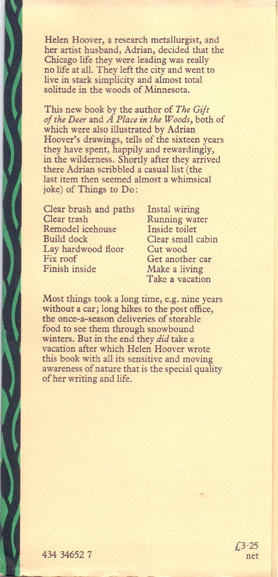
This book was published five years after "A Place in the Woods" and it covers the 16 years Helen and Adrian Hoover spent in their cabin on Gunflint Lake, on the Canadian border in Minnesota. While the text on the book flap states that they spent those years happily and rewardingly this was not alway so and the book ends with their leaving the area.

On the one hand this is the story of how Helen and Adrian make the cabin their home and how they cope with living in northern Minnesota, with its harsh climate. On the other it is a record of the nature that surrounds them and the animals that come to visit.

As we learned in Helen's earlier book, living in the woods in hard work. Even in spring or summer things don't get much easier: "the mosquitos and black flies were out in full force, ready for their coming task of fertilizing the flowers, and they bit so ferociously that we gave up on outdoor work." They don't hunt or fish and the very short summer season makes it very difficult to grow vegetables. They do keep a few chickens (in a heated run in winter). But mostly they depend on mail order and deliveries of food and oil. Missing an oil truck delivery, or being snowed in with little food, are potential disasters. Their first years in the cabin are very hard, as they struggle to pay their bills. They earn just enough money selling notepaper printed with Adrian's designs and they live on such an unbalanced diet that at one time Helen even suffers from scurvy. 


 "Ade and I had come to the forest believing that we would have to work harder than we had ever worked and thinking the depression years had prepared us, but we discovered they had been relatively easy. We had been poor in the sense of having to cut corners during our first year and a half in the woods. Two years later we were poverty stricken - cold, hungry, ragged, sick and touched by flashes of paralyzing terror. This was not the fear of death but the fear of living, of never having some small pleasure or physical comfort of a moment free of worry so long as life should last. (...) And yet I warmed to the happy moments we were finding in this innocent forest. The wild creatures were our friends and companions, our teachers, our entertainers ..."

Gradually Helen starts to earn some money when she sells magazine articles and the hard years are over when she gets her first book contract.

"When the book was roughed out, I roamed the forest, burdened with two field guides that I carried around my neck in a two-pound clothespin bag, checking my reported observations for accuracy. (...) When I grew tired I sat at the base of a big pine or spruce, leaned back, and closed my eyes. My skin grew sensitive to the touch of the special air of spring, the drier air of summer. Faint creakings told me of branches rubbing together. One day my nose crinkled to an acrid scent, something like rancid oil, and I opened my eyes to see a black bear strolling toward me. I sat without moving while he came almost to my resting place, observed me with shifting eyes as I was observing him, sniffed and wandered away, presumably no longer curious."

Later in the book there a more encounters with (hungry) bears and one winter things become so dangerous, as bears could easily smash their doors and windows, that they go and spend some time in a motel.

While they still encounter a lot of kindness, they are also seen as weirdos, living without a car and refusing to have a power line put in (because it would mean cutting down lots of trees). They also refuse to cut down trees or use DDT during an infestion of budworms that takes a few years. In the end their policy of letting nature take care of itself pays off. 

A lot of animals, especially deer, come to the cabin in winter, in search of food.  They order food for animals but word gets round and this attract hunters, and some of the deer that have been visiting them for years are killed.

With the extra money they earn they do up their cabin and they can afford a few more luxuries, but things start to change: the road is repaired, more tourists come, the solitude they cherished is gone and they begin to feel uncomfortable where once they were so happy.

"Power, phone and road together attracted more and more people, which meant more and more building. This necessitated clearing, which increased run-off water and silting of the lakes, and the installation of many cesspools that released an effluent that stimulated algae growth in the clear water, as the privies of the old days had not done. More planes and boats to accommodate the larger number of people added their oil films to the lake."  

In the end they take a vacation, the last item on their list (see book flap below), and start looking for another place to live.


If you would like to read more about Helen Hoover, a very good article by David Hakensen can be found here

Wednesday, 15 September 2021

Baking Bread, and Household Hints

Bara Hafod

A lot of "my" writers bake their own bread. Here is Elizabeth West's recipe, from Garden in the Hills.

"Put into a jug: 4 rounded teaspoonfuls of dried yeast, 3 rounded teaspoonfuls of sugar and about 1/4 of lukewarm water. Give it a stir around, cover with a cloth, and put to one side. Whilst you are waiting for the yeast to get working, weigh up 2 lb of flour - either wholemeal or plain white, or a mixture (I usually mix 11/2 wholemeal with 1/2 white). Put this into a mixing bowl. Sprinkle into flour a teaspoonful of salt. Mix well. Grease and flour two 1-lb bread tins. 

Now go and look at your yeast in the jug. It should be at least a quarter way up the jug, frothing and bubbling.  If it's not, then it's probably due to the yeast being stale - not necessarily your fault, I have found stale yeast in a newly opened tin - so give it a bit longer. In fact, go and do something else for ten minutes. If it is still the same when you come back, never mind. Carry on and use it. It just means that your bread won't rise quite so well. 

Make up the contents of the jug to about one pint with lukewarm water, and pour this into your flour. Using the right hand only (it's just as well to keep one hand clean) work the mixture around, squeezing and kneading between your fingers. After a while it should be one moist, pliable lump in the middle of your bowl, with no flour sticking to the sides. If it feels to dry, add some more lukewarm water. If, on the other hand, it is all sticky and wet, add some more flour. Divide the dough into equal pieces and put into your tins. Put the tins to one side, cover with a cloth and leave for about one hour. The dough should rise to the top of the tins (leave for longer if necessary). Put bread into a moderately hot oven for about 40 minutes. By this time you should be able to "bounce" them out of their tins (if they won't come out easily, slip a knife around their sides). I then usually put the loaves back into the oven, upside down, in order to get them crisp all over.

Please note that none of these measurements is critical. I have written down what I do. Alan doesn't measure anything. He simply throws in what he thinks looks right. Don't take any notice of instructions to "put it in a warm place to rise". You are more likely to put it into too warm a place. The temperature of the room in which you are working is quite adequate."

I notice there is very little kneading and only one rise, making it a simple recipe. During lockdown I made a similar "no-knead bread", which was OK, but I had to have my oven on, on its highest setting, for an hour, which I felt was using way to much energy for one small loaf. Besides, unlike Elizabeth West, there are many shops where I can buy bread near my home. Her telling us to knead with one hand reminds me of a friend who went to domestic science school in the sixties. She used to say that the one thing she remembered being taught was: always knead with one hand only, because the telephone might ring.

Household hints

Louise Dickinson Rich (whose We took to the Woods will be covered in a future post) tells us exactly how she butchers and preserves deer meat, which I guess not many of us will get a chance to do.  But she has two tips which I thought worth sharing:

- .... a pane of window glass which I put over my open cook book. I'm a messy cook, splashing flour and milk and batter and egg yolk all over the table. If they splash on the book, the pages will stick together and you can't use that recipe again, as I have found to my sorrow. If they splash on the glass, that's all right. Glass washes. 

- .... a way to crumb fish or croquettes or cutlets or what-have-you easily and quickly. I put my crumbs or flour in a paper bag, drop in the object to be crumbed, close the bag and shake violently. This does not sound like much of an invention but it saves an awful lot of mess. When you're through you have nothing to clean up. You just shove the paper bag into the stove and burn up the scanty leavings.

I'm going to try the crumbing in a bag. I usually use a plate and end up with my fingers coated in egg and crumbs, looking like they are ready to be fried too.


Thursday, 26 August 2021

A Place in the Woods by Helen Hoover, illustrated by Adrian Hoover (1968)

After Adrian Hoover becomes ill he and Helen spend two months in northern Minnesota, but when the time comes to go home they decide to stay (this is in 1954). In Chicago Adrian worked as an art director of a publishing firm, and Helen was a research metallurgist in a laboratory.

Someone later tells Helen: ". . . but you might as well know that some people up here have been betting - really betting, I mean - that you won't stay the winter"

This is hardly surprising. While Adrian is the ultimate handyman, and it seems they have visited this area before, both Helen and he are strangely naive about living there. For instance, it seems it has not occurred to them that they might need warm clothes in winter.  Helen also hadn't realised she does not need a fridge or freezer: Adrian sat down and laughed till he choked. Finally: "How were you ever so good in science? Look:"He waved a hand at the window. "Out there everything is frozen and will stay that way, in the shade at least, until spring". I do like Helen for telling us all this.


Their time in the woods starts with a series of mishaps.The first cabin they buy, which is not very well made, is damaged by heavy rain and floods which wash away part of the basement (this coincides with a very scary visit by a bear when Helen is on her own). By one stroke of good luck they find someone to make repairs, and by another the neighbouring cabin is for sale. This looks much nicer, plus it comes with lots of furniture that they like. But there is one thing they haven't taken into account: this cabin is only built for summer use. So it is back to the first cabin again for winter, and they head into town (a three hour drive in good conditions) to buy provisions, warm winter clothes and to collect their mail order purchases, which include two stoves. On the way back to the cabin, they collide with another car. Running out of money, recovering from the accident and stuck in the cabin without a car, Adrian misses an appointment to sign a contract which could have earned him a lot of money. But as Helen says: "if he had been there on time to sign the contract we'd have had an easy life and another car. And it is very possible that I should never have written anything except letters to my friends". 


They adapt to life in the cabin, getting to know the land and the animals that live there. One morning Adrian calls Helen to come outside. "Frost, he said in an awestruck voice. "It's frost".  I've always thought of frost as something white sprinkled on grass like sugar, but this was a feathery miracle. Every twig was fringed by it, every branch festooned, every bud tufted. Delicate ice plumes hung inches long from our eaves. The windows were barley sugar and the cabin logs were netted over by tiny ice fans.


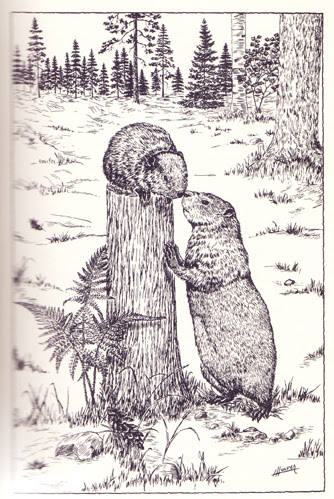
The snow stopped before dark, as suddenly as it had begun and Ade and I stepped out to look at the fresh white. The silence was so deep that I could hear my blood throbbing in my ears. The air carried a scent like the taste of snow. A feeling of being watched from the white forest was very strong. "They're all around us", I said. "The natives. We're a minority of two". During the winter they get to know some of those natives, among them mice, deer, birds, squirrels, weasels and an animal I had never heard of: the fisher (see picture below).

They need to find a way of making money and buy a mimeograph, which they use to produce note paper decorated by Adrian. This sells well. He also manages to sell woodwork. Another small source of income is taking care of a rain gauge for the US Weather Bureau. By the end of the book Helen has sold a few articles to magazines.

During the winter Adrian reads from David Copperfield while Helen crochets or embroiders. Copperfield was a fortunate selection because from it came the motto that for several years was tacked onto a log in the kitchen: SOMETHING WILL TURN UP.  J.Wilkins Micawber.


The winter passes. Helen looses track of time and is astonished it already is 19 February. I looked up and across the lake to the clear blue above the far hills and thought about my disorted time sense that seemd to have lost me three weeks. But it wasn't really distorted and I hadn't lost anything. I'd just been seeing things in a way that was new and different to me, a way that I'd probably known in early childhood and forgotten.

They are happy with what litle they have.

A Chicago friend wanted to know when we were coming back to civilazation. I looked out of the window and up through the bare lacework of a birch top to the blue, blue sky. I smelled the faint fragrance of balsam smoke from the stove. I listened to the querulous piping of some nuthatches. I thought of the woodpiles and my white ceiling and the stored groceries - all of the fall work behind and the winter chores ahead. Of the dim, tantalizing glimpses of possible independent careers. Civilization? We were as civilized in our forest setting as my friend was in het concrete beehive, but it would be useless to try to tell her so.

I could quote from this book endlessly. A recent acquisition and an instant favourite, it has everything:  domestic and financial detail, hardship, nature, animals, the kindness of strangers and of course a map. Helen wrote 7 books for adults (also some children's books). The Years of the Forest is another book about their cabin life, which I will cover in a future post.


Wednesday, 18 August 2021

Back home again

Sorry for the poor lay out. Blogger is giving me a hard time with pages full of code. I hope they sort this out soon, so far I haven't had any response to my questions. Anyway, we are back from cycling to Berlin. Cheated a bit in the Harz: as the hills were a bit too steep for us we took the train! Now it is back to reading for the blog. I still have many titles to cover. Also I have received recommendations from Avis, who likes: The Shepherds Life by James Rebanks, Counting Sheep by Philip Walling, Corduroy by Adrian Bell, Glory Hill Farm by Clifton Reynolds, Fools Rush in by Tina Spencer-Knott, and books by AG Street. And Sue told me about these: Hope Bourne - Wild harvest, Neil Ansell - Deep Country, Denise Hall - Stones and Stars, Sally Borst - Self Deficiency, Daniel Butler -Urban Dreams, Rural Realities, Anne Cholawe - Island on the Edge, Patrick Rivers - Living on a Little Land, Katherine Stewart - Croft in the Hills, Hilary Burden - A Story of Seven Summers. Some of these I already own, others I will keep a lookout for. As it is I have a few shelves that I mean to cover in this blog first:
Back soon!

Thursday, 22 July 2021

Holiday reading: recommended books

No farms today, instead I thought I'd list some of my favourite holiday reads. On holiday I like to read books that have lots of pages and, as they say in Dutch 'lezen als een trein' ('read like a train'), i.e. once you start you can't stop. Here are some books that I have enjoyed and can wholeheartedly recommend. I would love to hear what your favourites are.

Ann-Marie MacDonald: The Way the Crow Flies (2003, 810 p.) From the back flap: Both a head-spinning murder mystery and an exploration of morality, innocence lost, and the length to which parents and children will go to protect one another. Astonishing in its depth and breadth, The Way the Crow Flies artfully weaves one family's struggles into the fabric of the Cold War. This had me hooked from the start. When I got an inkling about the way the story would develop I stopped reading for a few days, because I cared so much about the characters. Just had to finish it though.

Norman Collins: London belongs to me (1945, 738 p.) I read a recommendation somewhere and ordered this book right away (it is a Penguin Modern Classic). This is the story of the inhabitants of a boarding house in Kennington in 1938. From the back flap: With deadpan humour, London Belongs to Me portrays a world of séances, shabby gentility, smoky pubs and ordinary lives in an extraordinary city. I took it with me when we were going to spend Christmas with friends. I became ill, spent a few days in bed and devoured this book. 

Catherine Fox: Acts and Omissions (Lindchester Chronicles part 1, 2014, 328 p.). Having read Catherine Fox's three novels I kept hoping for more. She has a way of making you love her characters, and you want to know what happens to them after the book finishes!  I knew that she had written novels about the Church of England, but I assumed they would not be my thing. But then I read somewhere that characters from her earlier novels return in these stories so I ordered them like a shot. I am so glad I did. I think Acts and Omissions (first written in instalments on Catherine's blog) is the best one: it is warm and witty and wise. Very funny, but some parts still bring tears to my eyes. I recommend this even if you know little about or have no interest in the Church of England: it is about people.

There are three more Lindchester Chronicles: Unseen Things Above, Realms of Glory, Tales from Lindford (this was blogged in instalments during 2020).

Dervla Murphy: Where the Indus is Young (1977, 266 p.) and On a Shoestring to Coorg (1976, 256 p.). I am a big Dervla Murphy fan and these two books are my favourites. Dervla had already published a few books on her travels when she had her daughter, Rachel. In On a Shoestring to Coorg she takes five year old Rachel to South India. This is " Rachel's apprenticeship to serious travelling. In effect, this decision meant not organising it; we would fly to Bombay and slowly wander south to Cape Comorin, planning our route on a day-to-day basis. As things turned out, these inconsequential ramblings had the happiest results" This is slow travel at is best. We see India through Dervla's and through Rachel's eyes. In Where the Indus is young Rachel and Dervla spend a winter in North Pakistan, travelling on foot with a mule to carry their luggage. I love Dervla's eye for the practical and the domestic: what is it like to keep house and cook in very primitive circumstances? These are details you don't often read about in other travel books.

I hope you will enjoy these books too. I would love to hear what your favourites are. I will be away from my desk for a while, so I may not be able to react at once. Have a great summer!


Friday, 16 July 2021

Copsford by Walter J.C.Murray (1948)


Little Toller Books have recently republished Copsford. From their website:
"The classic account of a young man’s life in rural Sussex, away from his city life – a year in which he rented a derelict cottage and scratched a living from selling dried herbs and wildflowers. Bearing comparison to Thoreau’s Walden, Murray’s intense feeling for his place is evident on every page. For all that it is no simple story of a rural idyll – life at Copsford was difficult and Murray does not shy away from the occasional terrors of a house that had its hauntings.

Walter J. C. Murray was born in Seaford, Sussex, a county where he spent most of his life. He served in the Merchant Navy and RAF during the First World War, after which he worked in London for a short time as a journalist. Disillusioned with city life, he moved to Horam and lived hand-to-mouth as a writer and collector of wild herbs and flowers, before becoming a teacher. In 1923, he founded a small school of which he remained the headmaster for forty years. Murray was also a well-known nature photographer, broadcaster and writer whose books include Nature’s Undiscovered Kingdom (1946) and Copsford (1948)."


I bought this book years ago, and as the bookmark showed, did not get very far. I liked the first chapters in which Murray describes finding the cottage and doing up a room on the 1st floor to live in, including wallpapering it. Wallpaper! In a house with most of the rooftiles missing and no windows! I would think the house would have been pretty much unlivable in when it rained and snowed, but he only mentions stains in the wallpaper in a later chapter.
Trying to eradicate the rats who had taken up residence was also entertaining. But the chapters on collecting plants I found boring. This time I forced myself to finish the whole book.  Raynor Winn says in her introduction to the recent reprint: „Copsford has an innocence, a freedom in thought… Anyone who has dreamt of spending time alone in the natural environment will connect with Murray’s emotions.” Well, I enjoy spending time alone in nature, but reading about someone’s thoughts and emotions about it is really not my thing. So this is not my book, sorry. But I know many people like it so here are two recent reviews by bloggers who clearly did love it:
Notes for the Curious
Caught by the river

A film on finding the location of the house (no longer there) at Copsford (East Sussex) can be found here 

Tartarus Press have also republished Copsford.

Monday, 12 July 2021

Betty Dougherty continued and This and That

After writing the post on Betty Dougherty I found a 1980-82 Writers Directory on the Internet, listing Betty's address as 2 Mount Pleasant, Wades Lane, Lower Raydon, Ipswich. Postcode IP75QW. As Sue had already pointed out, Betty's house is still there, but with a hugh extension.

Here is a drawing I did not use in my earlier post. Betty demolished the remains of a bread oven outside her house. She found out from one of her neighbours what it used to look like.


In other news: some of the plants on my balcony have grown very tall. After a stormy day last week some of them just flopped over, so yesterday I tidied things up. Some nicotinia have ended up in a vase, giving out the most wonderful scent. But, just like the ones still in their containers, only in the evening.


And, hurray, the Sunday flea market in the square near our home has returned. I got a down winter coat for 6 euro's and a denim shirt for 1 euro. Very pleased!


Monday, 5 July 2021

Betty Dougherty: Green Gardener: Creating a Wild Garden (1975)


So far, I have gardened in two small gardens and on one large balcony. I hardly ever consult gardening books or the Internet: I just like to try out things and see how I get on.  On the other hand, I love books about how someone made a garden. One of the first „garden stories” I bought is this one. I bought it in 1977, I know that because back then I still made a note of the purchase date and place in my books. At the time I was a student living in a flat and I can’t remember having an interest in gardens. Still, something must have attracted me to the book. Having just reread it I think it must have been the story of the discovery, buying and developing of the house and garden rather than the information on plants (of which there is a lot). When she wrote the book Betty Dougherty was Head of the Graphic Design Section of the Design Council in London. I guess this must have been based in the Design Centre in Haymarket. During the 70’s and 80’s I used to visit London at least once a year. The first thing I always did was visit the Design Centre in Haymarket, followed by tea and cake at Patisserie Valerie in Soho (this was before it became a chain). Then one year, the Design Centre had vanished. A shame, they had some great exhibitions and a nice shop. I haven’t been able to find out much about Betty Dougherty. She seems to have written books on leatherwork and linocraft, assuming that is the same Betty Dougherty. A second volume of practical advice to gardeners (as mentioned on the cover of this book) does not seem to have materialized. In this book she describes how she buys a semi-detached cottage in Suffolk as a second home. 


At first all her time is spent doing up the cottage. Many friends come to help her. On the title page the subtitle is” How an amateur created a wild garden” and an amateur is what she is. In fact it seems as though at first she gives little thought to the fact that she had acquired a garden. However once renovation of the house is complete she is bitten by the bug and becomes a devoted gardener.
The plan of the garden is partly determined by trenches dug by laborers and by discoveries made by clearing out the garden. Thus a bed in the shape of a boat is made and a sunken paved garden is discovered. 


This is a great book for lovers of heathers and conifers as she becomes devoted to them.  She also discusses many other plants (there is an index) and her experiences, triumphs and mistakes. Challenges are the wind and rabbits. Reading it now I was astonished at the casual use of weed killers; perhaps this was normal in the 70’s?  I like how she describes how she falls into the trap of planting too much (haven’t we all?), without considering that plants will grow …. After a few years she is able to buy the second half of the house and to merge the gardens. Now she has enough room for all those extra plants! 


In the last chapter she mentions moving to the house permanently (nrs. 1 and 2 in the plan below).


I tried to find the house on Google maps /satellite view and as far as I can tell there are now two large new buildings and a golf course in its place.

Tuesday, 29 June 2021

Back home again


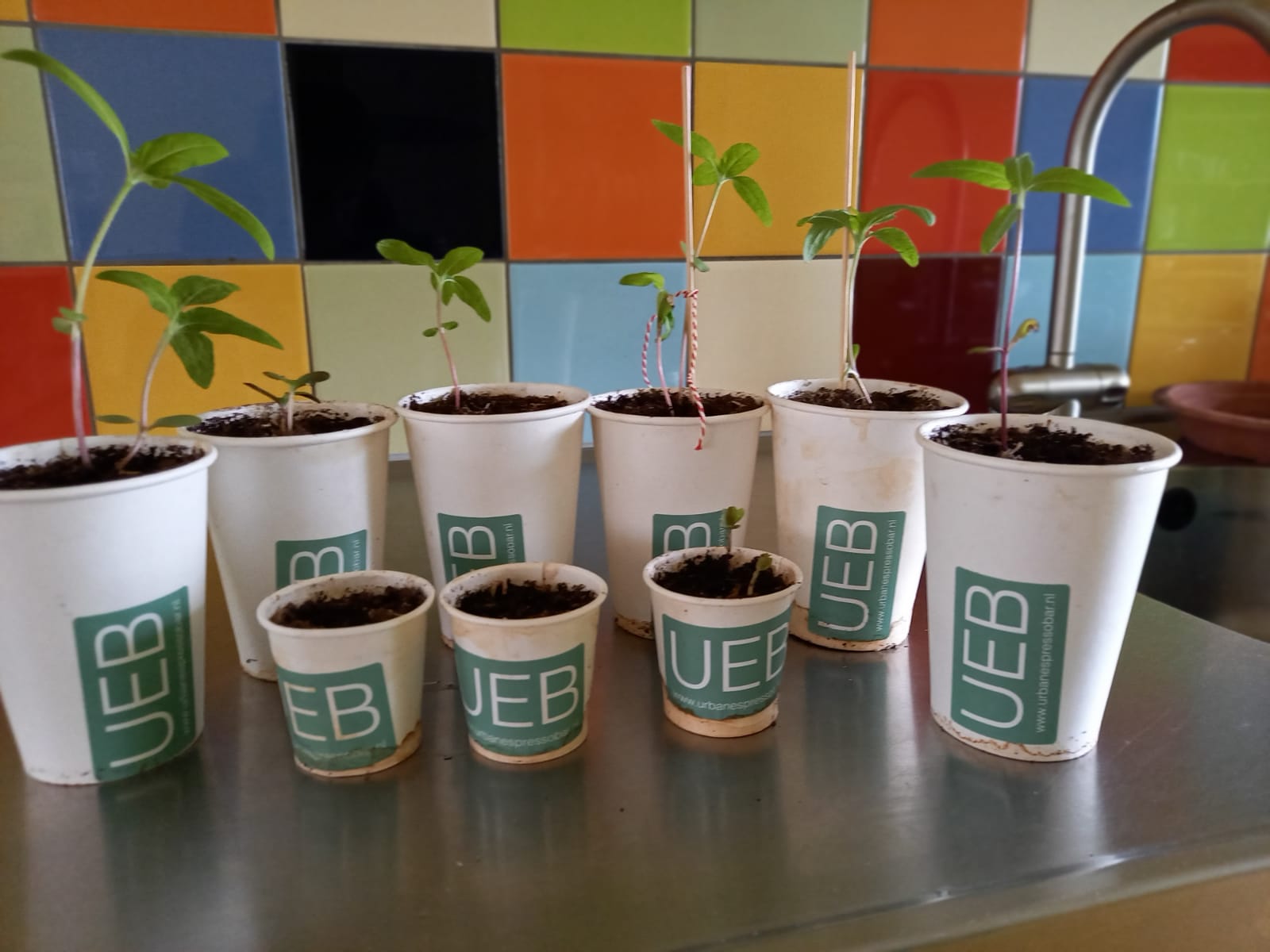
After a week away we came home to this colourful jungle. I have been using a new seed mix (to attract bees and butterflies) and I am very pleased with it. The sunflowers have surprised me, as the seedlings were very floppy and even needed support, as you can see here:

(I used cups from our favourite coffee place)

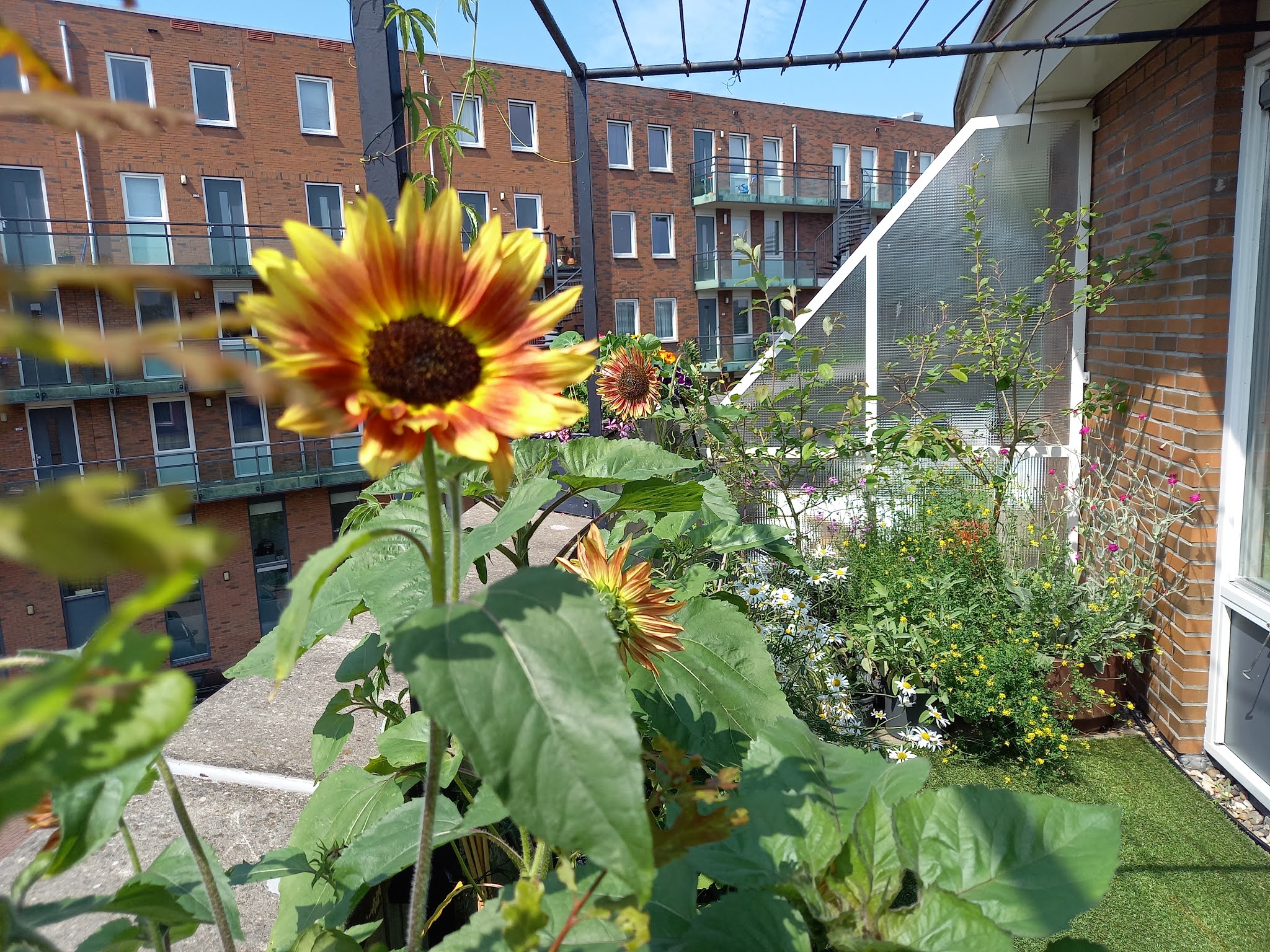
And now they look like this:

Sweet peas and morning glory are doing well, passionflowers are racing to the top of the pergola. I also have caterpillars eating the leaves of some shrubs, but, oh well, let's hope they turn into beautiful butterflies!

I hope to get around to posting about a book soon, but this being summer, there are many temptations outside. Maybe another cycling trip . . . I am very pleased to see more people are finding this blog.  Welcome everyone!    


Sunday, 13 June 2021

My New Forest Home by Irene Soper (1996)


Added in september 2023: This is my most popular post. If you are interested in Irene Soper and/or Juliette de Bairacli-Levy don't forget to read all the comments, as people have added interesting information.
Also read my other posts on Irene Soper.


I ordered this book knowing just the title. It turned out to be the story of Irene and her husband Arthur, both artists, who have lived in the New Forest for about 30 years.
The New Forest is one of the largest remaining tracts of unenclosed pasture land, heathland and forest in Southern England, covering southwest Hampshire and southeast Wiltshire. It was proclaimed a royal forest by William the Conqueror, featuring in the Domesday Book. It became a National Park in 2006
Irene and Arthur live in Abbots Well, near Frogham. In their garden is a small cottage, which used to serve as a home, lastly for herbalist and writer Juliette de Bairacli-Levy. They do up this cottage (including re-thatching), which they then use as a studio.
Irene’s garden is surrounded by the forest and is visited by many birds, rabbits, badgers, foxes and stoats.  
They become enthusiastic beekeepers. Irene writes that many people in the New Forest used to keep bees, and that at one time it was famed for mead. I knew mead was made with honey, but I had no idea the caps (cut off the honeycombs) and wild comb (pieces of wax made by bees to fill up gaps) were used as well.
This is her mead recipe: Place cappings and pieces of wild comb in a pan, add enough cold soft water or rainwater to cover, and bring to the boil. Simmer gently until the wax rises to the top. Allow to cool. Remove the wax, strain the remaining liquor into a covered vessel. When luke warm stir in one teaspoonful of mead yeast and put in a warm place to ferment. When bubbling has ceased, strain into a cask with air-lock and store for a year before bottling off.

They are also avid badger watchers. First around their house: Arthur even riggs up an alarm system so they know when a badger is entering their garden. Later they go out and discover badger setts and badger watch in the evening. This involves sitting or standing still for long periods dressed in mosquito proof clothing (wellies, leather gloves, net veil over the face).

They delight in exploring the surrounding forest.
Standing on the hill that mooring I realized just how much there was to explore - the Forest around Abbots Well offered great variety. There was open moorland with large stretches of furze (or gorse) and heather where many species of birds were to be seen and which gave cover to several foxes’ earths. There were wooden enclosures where badgers had their setts and deer grazed peacefuly beneath the shade of the leafy branches. Peat-stained streams meander their way through wooded glades and open moorland, here and there opening out to deep pools where small brown trout would lie. Treacherous bogs were numerous, deceptive in beauty with bright green moss, colorful flowers and rushes.
While searching for mushrooms they often come across fragments of Roman pottery. In certain places there is so much that moles throw it up when they dig and it can be found on top of their mounds.

The New Forest is famous for its ponies: Probably the picture which comes to mind at the mention of the New Forest is that of ponies. They appear on postcards and calendars and are the subject of very tourist’s snapshot. As they are running free the give the impression of being wild but each one has an owner and carries a brand-mark to prove it.
Spring is perhaps one of the best times for the ponies as they can enjoy the sunshine without the tormenting flies which come with the summer. In spring too the new foals arrive. It is always interesting to watch the mares leave the village in the evenings and make their way up Hampton Rudge to the open Forest where they spend the night, and to see them return again in the morning with perhaps a new foal born overnight running with them.

The Forest has many products to offer in one way or another: From olden times to this day the forester has taken advantage of this and turned them to good use. Apart from food, rabbits, hares, wild berries and fungi, which were all available to the peasant, there were materials such as heather, bracken, timber and peat.

Irene ends the book with tips for making a potpourri of forest finds to capture a tiny bit of the Forest to last you through the winter, using gorse petals, golden bracken, seeds, catkins, nuts, lichen, larch cones, pine needles,wood chippings, sloes, rose hips and bark.

I have not been able to find any information on Irene or Arthur Soper. The publisher (Ex Libris Press in Bradford on Avon) still exists, so I plan to contact them. Irene also wrote a cookbook: New Forest Cookery (1983).
Juliette de Bairacli-Levy wrote many books, among them Wanderers of the New Forest (1958).

Sunday, 6 June 2021

Glad Wild Rooster?


What's this? A new species? A new song by the Rolling Stones? No: it is " slippery cattle grid" in Dutch! We came across it on a recent cycle/camping trip. We went to Oostvoorne, a village on the coast south west of Rotterdam. Apart from a few stretches, we cycled on separate cycle lanes, like the ones in the pictures. After a very wet month of May we now have sunshine at last. As most local authorities don't mow the grass verges any more there were lots of wild flowers to admire and there was the wonderful smell of cow parsley, hawthorn and other plants I don't know the English names of. Best of all was the  bird concert we heard from dawn to dusk. Living in the centre of Rotterdam all we hear is a blackbird, pigeons, seagulls and magpies, so this was a real treat.


Back home after only three days, the plants on my balcony seemed to have exploded! You can see part of the watering system I bought last year. It is very nice having a large balcony and I do enjoy looking after the plants, but I felt I could no longer ask my neighbours to water them when we went away. It was a bit of a faff installing it, but now it works quite well. The hoses are attached to a timer on the tap, which turns the system on twice a day. As you can see I also have a water butt, but I use up all the water in a few days and it is now completely empty. Hoping for rain again! Some of the containers I found in the street: a large basket, rubbish bins, a laundry basket and a baby bath! They work just as well as regular plant containers (we drill holes in them) and are free.

Anyway: back to books! Next post will be about the New Forest.


Friday, 28 May 2021

My Small Country Living (1984) by Jeanine McMullen

 Update (August 2025): if you are interested in Jeanine McMullen do read the comments from people who were inspired by her to move to Wales. There is also someone who now owns her car!


Jeanine McMullen and I are complete opposites. I like animals, which is why I don’t have any. I think they are best left to themselves. Above all I do not think animals are humans in disguise. Jeanine McMullen feels a strong need to surround herself with animals, even though by her own account she is an amateur and is often not equipped to look after them. Most of het animals are „ characters”, who „plot against her or put on acts” (most of the humans she meets are larger than life too).
Having said that I must admit I enjoyed these books: she is a good writer. I especially liked the glimpses she gives of her early life in Australia, with her mother, who worked as a nurse in the Outback. I wish she had given us more of those and of her life before becoming a broadcaster. Her obituary states she was a teacher and dancer, too. It made me curious about the rest of her life.

In her first book she tells the story of the impulse buy of a smallholding on a visit to Wales, and of her efforts to interest her bosses at the BBC in a radio programme on the subject. At first she shares the farm with „The Artist” who moves to live there full time, while Jeanine works in London, traveling to Wales in the weekends.
In 1975 she and The Artist separate. Jeanine moves to the cottage permanently, and later her mother, known as Mrs P joins her.  Although friends advise her to sell the cottage, Jeanine decides to stick it out, which means years of struggling to pay the bills. She is fortunate in having extremely nice neighbours, one of whom even moves in a few months to help her.
At the start of the story she owns several dogs, then she rapidly acquires homing pigeons, a rabbit, hedgehogs, chickens, ducks, geese, goats, pigs and a cart horse. They all come with special instructions, so to speak. Like Dolores the goat who wreaks havoc everywhere she goes: „ She was in truth the embodiment of every prejudice against the goat and she committed every single crime that legend lays at its door. But she did it with such zest, with such glory in her own wickedness and with so much joy in the sheer wonder of being alive that it seems impossible there had ever been a time when she hadn’t been effectively wrecking our peace and property”.
She meets vet Bertie Ellis: „ a battered red Mini, dragging its exhaust pipe noisily behind it, came to a halt at the gate. A face, adorned with round, granny glasses and a pair of luxuriant mutton-chop whiskers, appeared out of the window: I’m Ellis, it announced”. On his first visit Bertie tells her that her horse Doli, despite displaying all the symptoms is not in foal. „ She’s been having you on, the old sod." (…) I didn’t know who to hate most, Doli or Bertie.
The cottage is damp and droughty, and difficult to heat. Jeanine does not see her way to making any improvements, partly because of her finances and partly, as she quotes C.S.Lewis, because „nature laid on me from birth the utter incapacity to make anything”. She just adapts to her primitive surroundings.
In one of the final chapters her pig Magnolia, ill with peritonitis,  is put down by vet Bertie, who uses a very strong anaesthetic. The pig is buried on the farm.
Some months later she finds her whippet Merlin in a coma. He only just survives. It turns out he had been eating from the dead pig, which was not buried deep enough.
Even though her free lance work has virtually dried up, Jeanine keeps hoping to produce her programme on country life: „ the single most important thing I had learned, though, was that everyone who actually survives country life has a story to tell. I no longer wanted to do a programme about the happy peasant tilling his soil; I wanted to get on tape people like the men who drive the massive machines along tortuous lanes and down suicidal slopes to collect garbage from remote villages and farms, or the postmen who struggle through floods and snow and over icy roads to get the latest circulars safely delivered (…) As I worked and worried and walked in the wood, ideas for the programme multiplied. At the the same time, however, the memory of me as a professional broadcaster was fading fast, along with my credibility for the producers. So, as the programme took firmer shape in my mind, it became more and more obvious that I could no longer afford to stay in the place which would have given it birth… My earnings had dropped to a level which wouldn’t even service the mortgage…"
A totally unexpected legacy from her father in Australia puts her back on her feet financially. A year later she once again pitches her idea for a programme and this time she gets to make it. It went on to become a very popular programme on Radio 4. She also wrote two more books (which I will cover in later posts).

Jeanine does not give exact details as to the location of her cottage. Online, I found references to Llyn-y-Far-Fach.
Her obituary refers to her home in Llanddeusant.
She died  on 9th February 2010 at the age of 73.The funeral was at the Parish Church of St Simon and St Jude, Llanddeusant.