Tuesday, 29 June 2021

Back home again


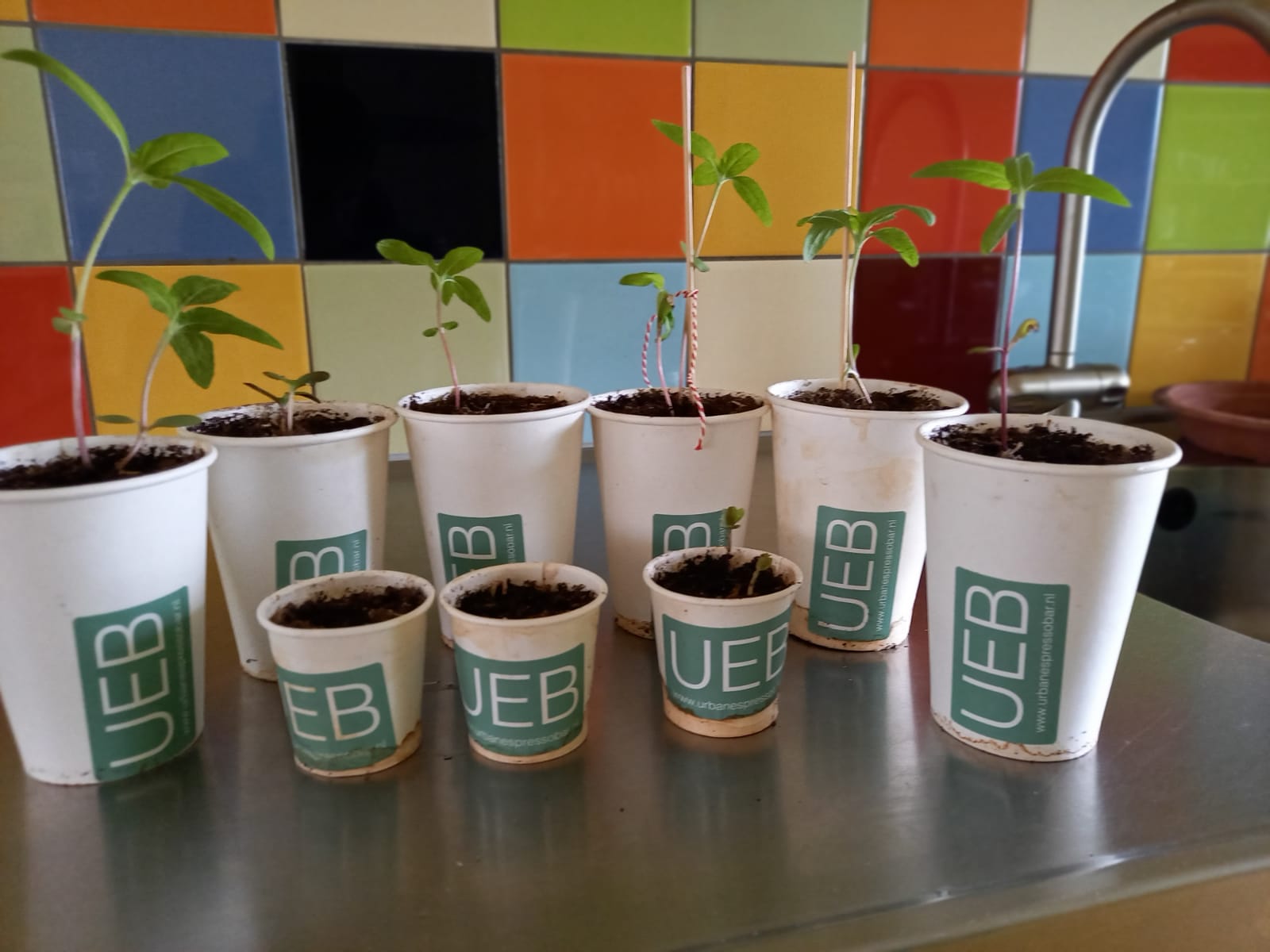
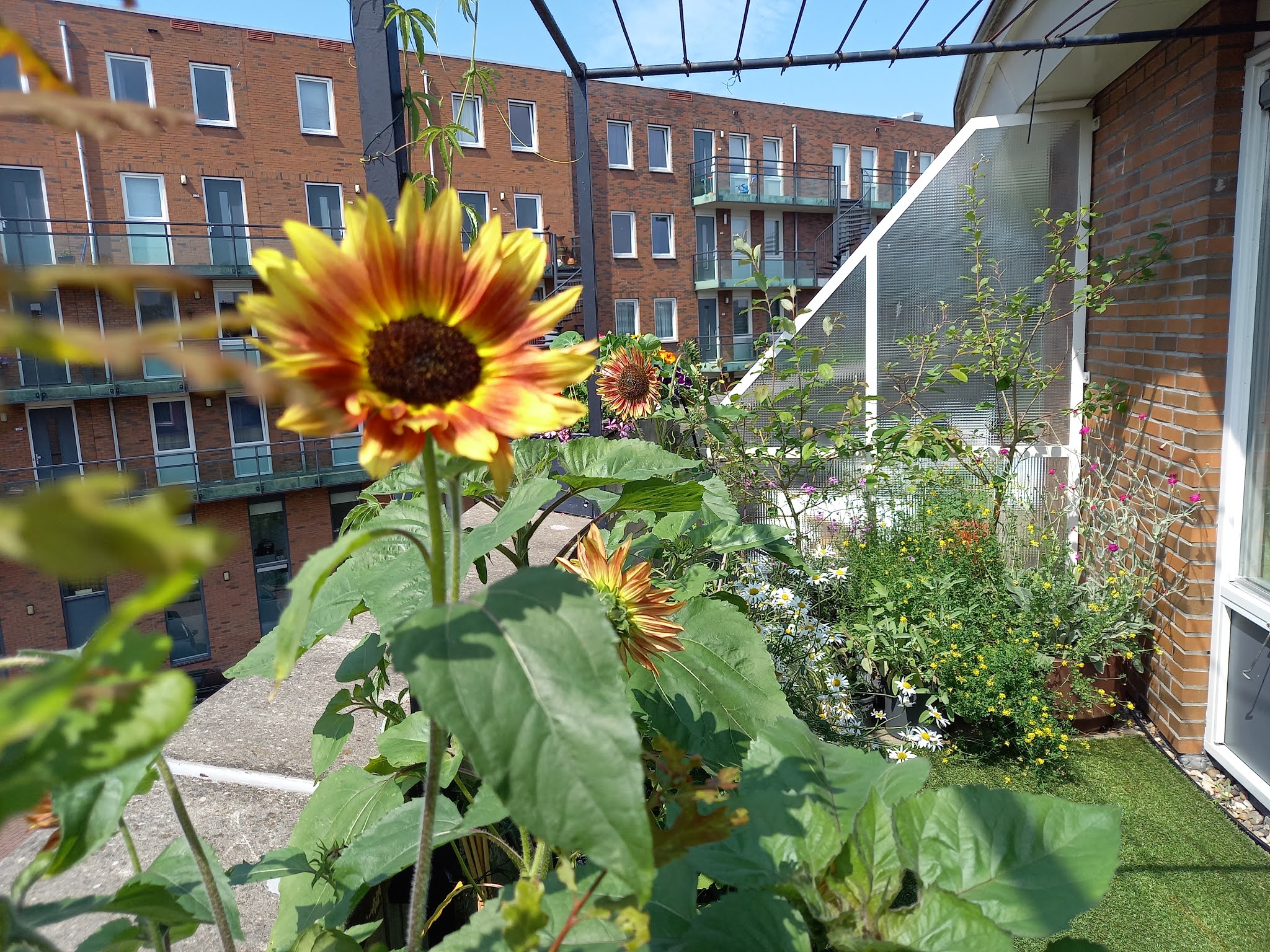
After a week away we came home to this colourful jungle. I have been using a new seed mix (to attract bees and butterflies) and I am very pleased with it. The sunflowers have surprised me, as the seedlings were very floppy and even needed support, as you can see here:

(I used cups from our favourite coffee place)

And now they look like this:

Sweet peas and morning glory are doing well, passionflowers are racing to the top of the pergola. I also have caterpillars eating the leaves of some shrubs, but, oh well, let's hope they turn into beautiful butterflies!

I hope to get around to posting about a book soon, but this being summer, there are many temptations outside. Maybe another cycling trip . . . I am very pleased to see more people are finding this blog.  Welcome everyone!    


Sunday, 13 June 2021

My New Forest Home by Irene Soper (1996)


Added in september 2023: This is my most popular post. If you are interested in Irene Soper and/or Juliette de Bairacli-Levy don't forget to read all the comments, as people have added interesting information.
Also read my other posts on Irene Soper.


I ordered this book knowing just the title. It turned out to be the story of Irene and her husband Arthur, both artists, who have lived in the New Forest for about 30 years.
The New Forest is one of the largest remaining tracts of unenclosed pasture land, heathland and forest in Southern England, covering southwest Hampshire and southeast Wiltshire. It was proclaimed a royal forest by William the Conqueror, featuring in the Domesday Book. It became a National Park in 2006
Irene and Arthur live in Abbots Well, near Frogham. In their garden is a small cottage, which used to serve as a home, lastly for herbalist and writer Juliette de Bairacli-Levy. They do up this cottage (including re-thatching), which they then use as a studio.
Irene’s garden is surrounded by the forest and is visited by many birds, rabbits, badgers, foxes and stoats.  
They become enthusiastic beekeepers. Irene writes that many people in the New Forest used to keep bees, and that at one time it was famed for mead. I knew mead was made with honey, but I had no idea the caps (cut off the honeycombs) and wild comb (pieces of wax made by bees to fill up gaps) were used as well.
This is her mead recipe: Place cappings and pieces of wild comb in a pan, add enough cold soft water or rainwater to cover, and bring to the boil. Simmer gently until the wax rises to the top. Allow to cool. Remove the wax, strain the remaining liquor into a covered vessel. When luke warm stir in one teaspoonful of mead yeast and put in a warm place to ferment. When bubbling has ceased, strain into a cask with air-lock and store for a year before bottling off.

They are also avid badger watchers. First around their house: Arthur even riggs up an alarm system so they know when a badger is entering their garden. Later they go out and discover badger setts and badger watch in the evening. This involves sitting or standing still for long periods dressed in mosquito proof clothing (wellies, leather gloves, net veil over the face).

They delight in exploring the surrounding forest.
Standing on the hill that mooring I realized just how much there was to explore - the Forest around Abbots Well offered great variety. There was open moorland with large stretches of furze (or gorse) and heather where many species of birds were to be seen and which gave cover to several foxes’ earths. There were wooden enclosures where badgers had their setts and deer grazed peacefuly beneath the shade of the leafy branches. Peat-stained streams meander their way through wooded glades and open moorland, here and there opening out to deep pools where small brown trout would lie. Treacherous bogs were numerous, deceptive in beauty with bright green moss, colorful flowers and rushes.
While searching for mushrooms they often come across fragments of Roman pottery. In certain places there is so much that moles throw it up when they dig and it can be found on top of their mounds.

The New Forest is famous for its ponies: Probably the picture which comes to mind at the mention of the New Forest is that of ponies. They appear on postcards and calendars and are the subject of very tourist’s snapshot. As they are running free the give the impression of being wild but each one has an owner and carries a brand-mark to prove it.
Spring is perhaps one of the best times for the ponies as they can enjoy the sunshine without the tormenting flies which come with the summer. In spring too the new foals arrive. It is always interesting to watch the mares leave the village in the evenings and make their way up Hampton Rudge to the open Forest where they spend the night, and to see them return again in the morning with perhaps a new foal born overnight running with them.

The Forest has many products to offer in one way or another: From olden times to this day the forester has taken advantage of this and turned them to good use. Apart from food, rabbits, hares, wild berries and fungi, which were all available to the peasant, there were materials such as heather, bracken, timber and peat.

Irene ends the book with tips for making a potpourri of forest finds to capture a tiny bit of the Forest to last you through the winter, using gorse petals, golden bracken, seeds, catkins, nuts, lichen, larch cones, pine needles,wood chippings, sloes, rose hips and bark.

I have not been able to find any information on Irene or Arthur Soper. The publisher (Ex Libris Press in Bradford on Avon) still exists, so I plan to contact them. Irene also wrote a cookbook: New Forest Cookery (1983).
Juliette de Bairacli-Levy wrote many books, among them Wanderers of the New Forest (1958).

Sunday, 6 June 2021

Glad Wild Rooster?


What's this? A new species? A new song by the Rolling Stones? No: it is " slippery cattle grid" in Dutch! We came across it on a recent cycle/camping trip. We went to Oostvoorne, a village on the coast south west of Rotterdam. Apart from a few stretches, we cycled on separate cycle lanes, like the ones in the pictures. After a very wet month of May we now have sunshine at last. As most local authorities don't mow the grass verges any more there were lots of wild flowers to admire and there was the wonderful smell of cow parsley, hawthorn and other plants I don't know the English names of. Best of all was the  bird concert we heard from dawn to dusk. Living in the centre of Rotterdam all we hear is a blackbird, pigeons, seagulls and magpies, so this was a real treat.


Back home after only three days, the plants on my balcony seemed to have exploded! You can see part of the watering system I bought last year. It is very nice having a large balcony and I do enjoy looking after the plants, but I felt I could no longer ask my neighbours to water them when we went away. It was a bit of a faff installing it, but now it works quite well. The hoses are attached to a timer on the tap, which turns the system on twice a day. As you can see I also have a water butt, but I use up all the water in a few days and it is now completely empty. Hoping for rain again! Some of the containers I found in the street: a large basket, rubbish bins, a laundry basket and a baby bath! They work just as well as regular plant containers (we drill holes in them) and are free.

Anyway: back to books! Next post will be about the New Forest.


Friday, 28 May 2021

My Small Country Living (1984) by Jeanine McMullen

 Update (August 2025): if you are interested in Jeanine McMullen do read the comments from people who were inspired by her to move to Wales. There is also someone who now owns her car!


Jeanine McMullen and I are complete opposites. I like animals, which is why I don’t have any. I think they are best left to themselves. Above all I do not think animals are humans in disguise. Jeanine McMullen feels a strong need to surround herself with animals, even though by her own account she is an amateur and is often not equipped to look after them. Most of het animals are „ characters”, who „plot against her or put on acts” (most of the humans she meets are larger than life too).
Having said that I must admit I enjoyed these books: she is a good writer. I especially liked the glimpses she gives of her early life in Australia, with her mother, who worked as a nurse in the Outback. I wish she had given us more of those and of her life before becoming a broadcaster. Her obituary states she was a teacher and dancer, too. It made me curious about the rest of her life.

In her first book she tells the story of the impulse buy of a smallholding on a visit to Wales, and of her efforts to interest her bosses at the BBC in a radio programme on the subject. At first she shares the farm with „The Artist” who moves to live there full time, while Jeanine works in London, traveling to Wales in the weekends.
In 1975 she and The Artist separate. Jeanine moves to the cottage permanently, and later her mother, known as Mrs P joins her.  Although friends advise her to sell the cottage, Jeanine decides to stick it out, which means years of struggling to pay the bills. She is fortunate in having extremely nice neighbours, one of whom even moves in a few months to help her.
At the start of the story she owns several dogs, then she rapidly acquires homing pigeons, a rabbit, hedgehogs, chickens, ducks, geese, goats, pigs and a cart horse. They all come with special instructions, so to speak. Like Dolores the goat who wreaks havoc everywhere she goes: „ She was in truth the embodiment of every prejudice against the goat and she committed every single crime that legend lays at its door. But she did it with such zest, with such glory in her own wickedness and with so much joy in the sheer wonder of being alive that it seems impossible there had ever been a time when she hadn’t been effectively wrecking our peace and property”.
She meets vet Bertie Ellis: „ a battered red Mini, dragging its exhaust pipe noisily behind it, came to a halt at the gate. A face, adorned with round, granny glasses and a pair of luxuriant mutton-chop whiskers, appeared out of the window: I’m Ellis, it announced”. On his first visit Bertie tells her that her horse Doli, despite displaying all the symptoms is not in foal. „ She’s been having you on, the old sod." (…) I didn’t know who to hate most, Doli or Bertie.
The cottage is damp and droughty, and difficult to heat. Jeanine does not see her way to making any improvements, partly because of her finances and partly, as she quotes C.S.Lewis, because „nature laid on me from birth the utter incapacity to make anything”. She just adapts to her primitive surroundings.
In one of the final chapters her pig Magnolia, ill with peritonitis,  is put down by vet Bertie, who uses a very strong anaesthetic. The pig is buried on the farm.
Some months later she finds her whippet Merlin in a coma. He only just survives. It turns out he had been eating from the dead pig, which was not buried deep enough.
Even though her free lance work has virtually dried up, Jeanine keeps hoping to produce her programme on country life: „ the single most important thing I had learned, though, was that everyone who actually survives country life has a story to tell. I no longer wanted to do a programme about the happy peasant tilling his soil; I wanted to get on tape people like the men who drive the massive machines along tortuous lanes and down suicidal slopes to collect garbage from remote villages and farms, or the postmen who struggle through floods and snow and over icy roads to get the latest circulars safely delivered (…) As I worked and worried and walked in the wood, ideas for the programme multiplied. At the the same time, however, the memory of me as a professional broadcaster was fading fast, along with my credibility for the producers. So, as the programme took firmer shape in my mind, it became more and more obvious that I could no longer afford to stay in the place which would have given it birth… My earnings had dropped to a level which wouldn’t even service the mortgage…"
A totally unexpected legacy from her father in Australia puts her back on her feet financially. A year later she once again pitches her idea for a programme and this time she gets to make it. It went on to become a very popular programme on Radio 4. She also wrote two more books (which I will cover in later posts).

Jeanine does not give exact details as to the location of her cottage. Online, I found references to Llyn-y-Far-Fach.
Her obituary refers to her home in Llanddeusant.
She died  on 9th February 2010 at the age of 73.The funeral was at the Parish Church of St Simon and St Jude, Llanddeusant.
 

Thursday, 20 May 2021

Ruth Janette Ruck and Ty Mawr

You can have a look inside Ty Mawr (now a holiday let), Ruth Janette Ruck's former home here

The story of both house and inhabitants can be found here

The farm is now owned by her son, John Orkney-Work. 

This interesting community site offers a description of a walk taking you past Carneddi farm.


Friday, 14 May 2021

Acorns

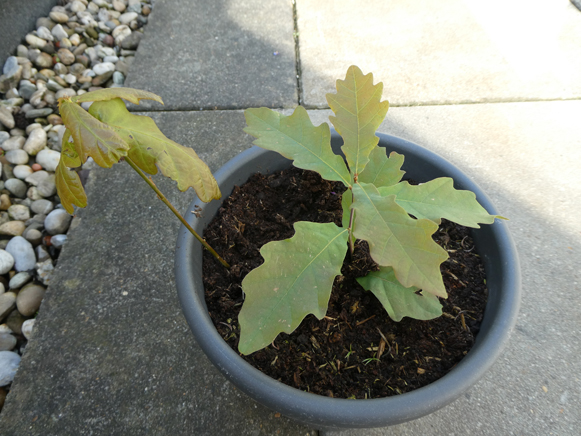
While cleaning containers I found two acorns, which must have been put there by birds. Intriguing, as I don't know of any oak trees near my home. Anyway, I now have two tiny ones in a pot!


Sunday, 2 May 2021

Hill Farm Story by Ruth Janette Ruck


Published five years after Place of Stones, this is a happy book.  While it remains hard to make a living on a small Welsh mountain farm (the first chapter is called „Making a Living Where a Rat Wouldn’t”), in her writing Ruth focuses on the joys of living where she does.
In one of the first chapters Ruth describes her wedding to Paul, who started working for the Ruck family some years before. It is a wonderful party, with the whole village taking part.
„In the first few days of married life I experienced a moment of panic. I wondered how to manage this small household, make good meals and keep the cottage clean, without expending extra time and money on doing it; there seems so little of either to spare. But Paul had no fixed ideas about what was women’s work and what was not. He could cook or wield a teacloth as the need arose and together we quickly finished the housework and were ready to go outside. Our expenses were few; there was paraffin for lighting and bottled gas for the stove, but the fire cost us next to nothing. The rates were only 6 pounds a year. We produced a good part of our own food and so we managed; my problem solved itself with a workable compromise.”


In the first chapter Ruth looks back on how she and her family started farming at Carneddi, copying other farmers’ work and relying on the help of two neighbours. One „took us under his wing and we were immensely grateful for the never-failing help and kindness which he gave. If he thought we were going wrong, he told us so: he hated to see mistakes and muddle, particularly where sheep were concerned. If we needed anything, from advice to a cup of tea or the loan of a plough, it was ours for the asking”.
She also tells the story of how she came to write her first book, filling exercise books when she can find the time. It takes nearly 3 years to finish. She is overjoyed to find it accepted by a publisher. After starting her second book their hen house is made into a writing hut.
She goes on to describe the day to day life on the farm: the sheep, the dogs, the decision to keep ponies and to enter them in shows;  and the joy Paul and Ruth find in mountain climbing.
They extend the farm by buying neighbouring farms and stock.


During the first months of 1963 the weather turns extremely cold:  "Washing froze stiff as a board within five minutes of its being hung on the line. The last of the kale in the field turned to green glass and shattered into fragments when we tried to cut it. The tap in the cowshed froze but we had given up swilling the floor several day earlier for fear of the cows slipping on the ice. I carried hatching eggs indoors in case they should freeze too.”
I was ten years old in 1963 and in The Netherlands the weather was similarly cold. Strangely I have no recollection of it, though our house must have been extremely cold as at that time we only had a heater in the living room. 1963 is also the winter that Dervla Murphy, one of my favourite authors, started her cycling trip to India. You can find the story in Full Tilt. I always wondered why she started her journey then, only to arrive in Pakistan and India in the extreme summer heat. She later said she had so often fantasized about this trip, that when she got her chance, she just could not wait.
Anyway, back to Ruth: she ends the book with a postscript: „It should be told because it gave a new perspective to our life. In the early summer of 1965 I began to wonder if I were pregnant”. She is, and Ann Jacquetta is born on 14 January. „ I look back on that time as one of the happiest of my life. (…) On January 24th, the day on which our baby was due to be born, we brought her home to the cottage in the mountains.


Wednesday, 28 April 2021

Seedlings

 I started this blog purely to write about books, but I would like to add a personal note. After all: it's my blog and I'll do what I want! 


My windowsills were covered in seedlings until yesterday. They were big enough to go outside, but alas: the night temperature kept going down to zero. Now I put them outside during the day, to acclimatize. "Outside" is a large balcony (15 by 2 meters), very sunny and sometimes windy. Today all "non-essential" shops re-opened, so I will be able to visit gardening centres too. But maybe I'd better wait as the temptation to buy is always great and I already have too many seedlings (they will go to neighbours and friends). Also cafes and restaurants will be allowed to open (outside seating only), so we will celebrate at our favourite lunch place.


Sunday, 18 April 2021

What to read where

 While looking for information on authors I came across this site:  https://www.mappit.net/bookmap/    It is a "Global Book Map"listing books about or situated in a particular location. There are more than 100,000 books on the map that can be searched by countries, regions, or by any of the thousands of specific places the books are set in or are about. So if you would like to read a book set in your home town or your holiday location this is the place to look.

For me it works the other way too: on a trip to Copenhagen I have visited the apartment block from Miss Smilla's Feeling for Snow (Peter Hoeg), in Edinburgh I have used locations from Alexander McCall Smith's books as my guide, and I have cycled round northern France trying, and failing, to find the hotel from The Greengage Summer (Rumer Godden). How about you, have you visited places from your favourite books?

Tuesday, 13 April 2021

Wild Island, a Year in the Hebrides by Jane Smith (2016)

I read about this book in Country Living (oh, I miss being able to buy British Magazines!) and ordered it in January 2020. In her book, Jane mentions Colonsay's Spring Festival, so I looked it up.  It sounded so wonderful I was beginning to think how nice it would be to visit when the world changed and all foreign travel was off. Maybe next year ...


In paintings and words Jane portrays a year on Oronsay, a small Hebridean island farmed by the RSPB for the benefit of wildlife. She originally worked for the BBC and National Geographic as a wildlife film-maker, then changed direction, studying painting and printing. 


Apart from the pictures, which are wonderful, she also has a way with words, painting a picture of life on the island and of all the creatures living there.


Mike and Val are the RSPB-managers on Oronsay, living there with their helpers and their dogs. You get to Oronsay by driving across from Colonsay at low tide, a hazardous undertaking at all times, and especially in bad weather or at night.


"On Oronsay I set to work, trying to understand what makes this place so rich in wildlife. The main conservation workers on the farm are the cattle and sheep, which shape the wildlife habitat by their grazing. There are different mouths for different jobs. Black-face sheep crop the field grass short so that choughs can feed, while Hebridean sheep have narrower mouths, and graze the rough hill-ground. Luing cattle grab mouthfulls of long grass in the wetter fields. As they poach up the ground with their feet, they create nesting hummocks for lapwings" (I looked up Luing cattle: they are a breed originally developed on the island of Luing)


" At first I find them (the seals) impossible to draw. They look like enormous slugs, galumphing around the shore. Shapeless. I remind myself that they are mammals with the same number of arm and leg bones as me, but in different proportions. They're like humans in sleeping bags. I imagine a skeleton hidden under all that blubber, and it helps".


This is a beautiful book to cheer you up when spring won't come. A great gift for anyone with an interest in art, The Hebrides, birds etc. Jane's website can be found here


Sunday, 4 April 2021

The Good Life, at a price!

 I always try to find out where the authors of my books lived and what happened to their houses. John Seymour wrote "The Fat of the Land" while living in a house near Woodbridge, Suffolk. He paid a peppercorn rent. Well, you can, or could (the information dates from 2019), rent it now for 1500 pounds per month! Details, including photo's can be found here   


Tuesday, 30 March 2021

Looe and Looe Island, then and now

When Evelyn and Babs Atkins bought their cottages in Looe they looked like this:


Today they are Grade II listed buildings


After Evelyn died in1997 Babs remained on the island alone until she passed away at the age of 86 in 2004. AS far as I can tell, Evelyn is buried in Looe, while Babs' grave is on the island. 

Additional interesting information on the sisters can be found here
and here .

Babs left the island to the Cornwall Wildlife Trust

Who knows, I may get to visit it this summer. Last year we had a holiday planned in the Scilly Isles.  It  was postponed to June this year and I have just postponed it again to August. When we do get to go I want to plan some extra stay on the South West Coast, so maybe . . .