Friday, 28 May 2021

My Small Country Living (1984) by Jeanine McMullen

 Update (August 2025): if you are interested in Jeanine McMullen do read the comments from people who were inspired by her to move to Wales. There is also someone who now owns her car!


Jeanine McMullen and I are complete opposites. I like animals, which is why I don’t have any. I think they are best left to themselves. Above all I do not think animals are humans in disguise. Jeanine McMullen feels a strong need to surround herself with animals, even though by her own account she is an amateur and is often not equipped to look after them. Most of het animals are „ characters”, who „plot against her or put on acts” (most of the humans she meets are larger than life too).
Having said that I must admit I enjoyed these books: she is a good writer. I especially liked the glimpses she gives of her early life in Australia, with her mother, who worked as a nurse in the Outback. I wish she had given us more of those and of her life before becoming a broadcaster. Her obituary states she was a teacher and dancer, too. It made me curious about the rest of her life.

In her first book she tells the story of the impulse buy of a smallholding on a visit to Wales, and of her efforts to interest her bosses at the BBC in a radio programme on the subject. At first she shares the farm with „The Artist” who moves to live there full time, while Jeanine works in London, traveling to Wales in the weekends.
In 1975 she and The Artist separate. Jeanine moves to the cottage permanently, and later her mother, known as Mrs P joins her.  Although friends advise her to sell the cottage, Jeanine decides to stick it out, which means years of struggling to pay the bills. She is fortunate in having extremely nice neighbours, one of whom even moves in a few months to help her.
At the start of the story she owns several dogs, then she rapidly acquires homing pigeons, a rabbit, hedgehogs, chickens, ducks, geese, goats, pigs and a cart horse. They all come with special instructions, so to speak. Like Dolores the goat who wreaks havoc everywhere she goes: „ She was in truth the embodiment of every prejudice against the goat and she committed every single crime that legend lays at its door. But she did it with such zest, with such glory in her own wickedness and with so much joy in the sheer wonder of being alive that it seems impossible there had ever been a time when she hadn’t been effectively wrecking our peace and property”.
She meets vet Bertie Ellis: „ a battered red Mini, dragging its exhaust pipe noisily behind it, came to a halt at the gate. A face, adorned with round, granny glasses and a pair of luxuriant mutton-chop whiskers, appeared out of the window: I’m Ellis, it announced”. On his first visit Bertie tells her that her horse Doli, despite displaying all the symptoms is not in foal. „ She’s been having you on, the old sod." (…) I didn’t know who to hate most, Doli or Bertie.
The cottage is damp and droughty, and difficult to heat. Jeanine does not see her way to making any improvements, partly because of her finances and partly, as she quotes C.S.Lewis, because „nature laid on me from birth the utter incapacity to make anything”. She just adapts to her primitive surroundings.
In one of the final chapters her pig Magnolia, ill with peritonitis,  is put down by vet Bertie, who uses a very strong anaesthetic. The pig is buried on the farm.
Some months later she finds her whippet Merlin in a coma. He only just survives. It turns out he had been eating from the dead pig, which was not buried deep enough.
Even though her free lance work has virtually dried up, Jeanine keeps hoping to produce her programme on country life: „ the single most important thing I had learned, though, was that everyone who actually survives country life has a story to tell. I no longer wanted to do a programme about the happy peasant tilling his soil; I wanted to get on tape people like the men who drive the massive machines along tortuous lanes and down suicidal slopes to collect garbage from remote villages and farms, or the postmen who struggle through floods and snow and over icy roads to get the latest circulars safely delivered (…) As I worked and worried and walked in the wood, ideas for the programme multiplied. At the the same time, however, the memory of me as a professional broadcaster was fading fast, along with my credibility for the producers. So, as the programme took firmer shape in my mind, it became more and more obvious that I could no longer afford to stay in the place which would have given it birth… My earnings had dropped to a level which wouldn’t even service the mortgage…"
A totally unexpected legacy from her father in Australia puts her back on her feet financially. A year later she once again pitches her idea for a programme and this time she gets to make it. It went on to become a very popular programme on Radio 4. She also wrote two more books (which I will cover in later posts).

Jeanine does not give exact details as to the location of her cottage. Online, I found references to Llyn-y-Far-Fach.
Her obituary refers to her home in Llanddeusant.
She died  on 9th February 2010 at the age of 73.The funeral was at the Parish Church of St Simon and St Jude, Llanddeusant.
 

Thursday, 20 May 2021

Ruth Janette Ruck and Ty Mawr

You can have a look inside Ty Mawr (now a holiday let), Ruth Janette Ruck's former home here

The story of both house and inhabitants can be found here

The farm is now owned by her son, John Orkney-Work. 

This interesting community site offers a description of a walk taking you past Carneddi farm.


Friday, 14 May 2021

Acorns

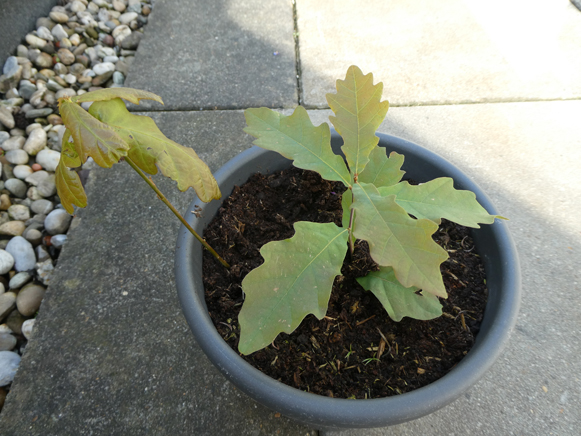
While cleaning containers I found two acorns, which must have been put there by birds. Intriguing, as I don't know of any oak trees near my home. Anyway, I now have two tiny ones in a pot!


Sunday, 2 May 2021

Hill Farm Story by Ruth Janette Ruck


Published five years after Place of Stones, this is a happy book.  While it remains hard to make a living on a small Welsh mountain farm (the first chapter is called „Making a Living Where a Rat Wouldn’t”), in her writing Ruth focuses on the joys of living where she does.
In one of the first chapters Ruth describes her wedding to Paul, who started working for the Ruck family some years before. It is a wonderful party, with the whole village taking part.
„In the first few days of married life I experienced a moment of panic. I wondered how to manage this small household, make good meals and keep the cottage clean, without expending extra time and money on doing it; there seems so little of either to spare. But Paul had no fixed ideas about what was women’s work and what was not. He could cook or wield a teacloth as the need arose and together we quickly finished the housework and were ready to go outside. Our expenses were few; there was paraffin for lighting and bottled gas for the stove, but the fire cost us next to nothing. The rates were only 6 pounds a year. We produced a good part of our own food and so we managed; my problem solved itself with a workable compromise.”


In the first chapter Ruth looks back on how she and her family started farming at Carneddi, copying other farmers’ work and relying on the help of two neighbours. One „took us under his wing and we were immensely grateful for the never-failing help and kindness which he gave. If he thought we were going wrong, he told us so: he hated to see mistakes and muddle, particularly where sheep were concerned. If we needed anything, from advice to a cup of tea or the loan of a plough, it was ours for the asking”.
She also tells the story of how she came to write her first book, filling exercise books when she can find the time. It takes nearly 3 years to finish. She is overjoyed to find it accepted by a publisher. After starting her second book their hen house is made into a writing hut.
She goes on to describe the day to day life on the farm: the sheep, the dogs, the decision to keep ponies and to enter them in shows;  and the joy Paul and Ruth find in mountain climbing.
They extend the farm by buying neighbouring farms and stock.


During the first months of 1963 the weather turns extremely cold:  "Washing froze stiff as a board within five minutes of its being hung on the line. The last of the kale in the field turned to green glass and shattered into fragments when we tried to cut it. The tap in the cowshed froze but we had given up swilling the floor several day earlier for fear of the cows slipping on the ice. I carried hatching eggs indoors in case they should freeze too.”
I was ten years old in 1963 and in The Netherlands the weather was similarly cold. Strangely I have no recollection of it, though our house must have been extremely cold as at that time we only had a heater in the living room. 1963 is also the winter that Dervla Murphy, one of my favourite authors, started her cycling trip to India. You can find the story in Full Tilt. I always wondered why she started her journey then, only to arrive in Pakistan and India in the extreme summer heat. She later said she had so often fantasized about this trip, that when she got her chance, she just could not wait.
Anyway, back to Ruth: she ends the book with a postscript: „It should be told because it gave a new perspective to our life. In the early summer of 1965 I began to wonder if I were pregnant”. She is, and Ann Jacquetta is born on 14 January. „ I look back on that time as one of the happiest of my life. (…) On January 24th, the day on which our baby was due to be born, we brought her home to the cottage in the mountains.


Wednesday, 28 April 2021

Seedlings

 I started this blog purely to write about books, but I would like to add a personal note. After all: it's my blog and I'll do what I want! 


My windowsills were covered in seedlings until yesterday. They were big enough to go outside, but alas: the night temperature kept going down to zero. Now I put them outside during the day, to acclimatize. "Outside" is a large balcony (15 by 2 meters), very sunny and sometimes windy. Today all "non-essential" shops re-opened, so I will be able to visit gardening centres too. But maybe I'd better wait as the temptation to buy is always great and I already have too many seedlings (they will go to neighbours and friends). Also cafes and restaurants will be allowed to open (outside seating only), so we will celebrate at our favourite lunch place.


Sunday, 18 April 2021

What to read where

 While looking for information on authors I came across this site:  https://www.mappit.net/bookmap/    It is a "Global Book Map"listing books about or situated in a particular location. There are more than 100,000 books on the map that can be searched by countries, regions, or by any of the thousands of specific places the books are set in or are about. So if you would like to read a book set in your home town or your holiday location this is the place to look.

For me it works the other way too: on a trip to Copenhagen I have visited the apartment block from Miss Smilla's Feeling for Snow (Peter Hoeg), in Edinburgh I have used locations from Alexander McCall Smith's books as my guide, and I have cycled round northern France trying, and failing, to find the hotel from The Greengage Summer (Rumer Godden). How about you, have you visited places from your favourite books?

Tuesday, 13 April 2021

Wild Island, a Year in the Hebrides by Jane Smith (2016)

I read about this book in Country Living (oh, I miss being able to buy British Magazines!) and ordered it in January 2020. In her book, Jane mentions Colonsay's Spring Festival, so I looked it up.  It sounded so wonderful I was beginning to think how nice it would be to visit when the world changed and all foreign travel was off. Maybe next year ...


In paintings and words Jane portrays a year on Oronsay, a small Hebridean island farmed by the RSPB for the benefit of wildlife. She originally worked for the BBC and National Geographic as a wildlife film-maker, then changed direction, studying painting and printing. 


Apart from the pictures, which are wonderful, she also has a way with words, painting a picture of life on the island and of all the creatures living there.


Mike and Val are the RSPB-managers on Oronsay, living there with their helpers and their dogs. You get to Oronsay by driving across from Colonsay at low tide, a hazardous undertaking at all times, and especially in bad weather or at night.


"On Oronsay I set to work, trying to understand what makes this place so rich in wildlife. The main conservation workers on the farm are the cattle and sheep, which shape the wildlife habitat by their grazing. There are different mouths for different jobs. Black-face sheep crop the field grass short so that choughs can feed, while Hebridean sheep have narrower mouths, and graze the rough hill-ground. Luing cattle grab mouthfulls of long grass in the wetter fields. As they poach up the ground with their feet, they create nesting hummocks for lapwings" (I looked up Luing cattle: they are a breed originally developed on the island of Luing)


" At first I find them (the seals) impossible to draw. They look like enormous slugs, galumphing around the shore. Shapeless. I remind myself that they are mammals with the same number of arm and leg bones as me, but in different proportions. They're like humans in sleeping bags. I imagine a skeleton hidden under all that blubber, and it helps".


This is a beautiful book to cheer you up when spring won't come. A great gift for anyone with an interest in art, The Hebrides, birds etc. Jane's website can be found here


Sunday, 4 April 2021

The Good Life, at a price!

 I always try to find out where the authors of my books lived and what happened to their houses. John Seymour wrote "The Fat of the Land" while living in a house near Woodbridge, Suffolk. He paid a peppercorn rent. Well, you can, or could (the information dates from 2019), rent it now for 1500 pounds per month! Details, including photo's can be found here   


Tuesday, 30 March 2021

Looe and Looe Island, then and now

When Evelyn and Babs Atkins bought their cottages in Looe they looked like this:


Today they are Grade II listed buildings


After Evelyn died in1997 Babs remained on the island alone until she passed away at the age of 86 in 2004. AS far as I can tell, Evelyn is buried in Looe, while Babs' grave is on the island. 

Additional interesting information on the sisters can be found here
and here .

Babs left the island to the Cornwall Wildlife Trust

Who knows, I may get to visit it this summer. Last year we had a holiday planned in the Scilly Isles.  It  was postponed to June this year and I have just postponed it again to August. When we do get to go I want to plan some extra stay on the South West Coast, so maybe . . .


Monday, 22 March 2021

Tales from our Cornish Island by Evelyn E. Atkins (1986)


This is one of my recent buys, 2nd hand from the UK. It came with that typically musty 2nd hand book smell.

I ended my last post by wondering what life on the island would be like for the sisters. This book gives the answer, and it can be summed up in three words: Very Hard Work.
Evelyn writes: We have often wondered how, on that radio programme Desert Island Discs, the castaways had the strength left to put on or listen to their eight records, let alone the time to browse through Shakespeare, the Bible and the tome of their choice. For us, in those early days, surviving was a full-time occupation - and often still is.

She starts by telling us she constantly gets questions on what it is like to live on an island. The book is an attempt to answer these questions. It is impossible to cover everything that has happened to them, so she has written a series of tales, each dealing with a different aspect of island life.
When she first moved to the island (in February 1965), Evelyn was on her own, helped from time to time by friends and volunteers. Her sister Babs, teaching in a school in Looe came over during weekends and holidays, sea and weather permitting.
The consensus of local opinion was we would last three months if we were not drowned before then.


Evelyn and her helpers face many challenges: taking care of the water supply, fixing the AGA and the generator, establishing a vegetable garden, harvesting the daffodils that grow on the island etc. They learn as they go along and adapt.
When you live close to nature you have to get your priorities right, and fussiness over food and drink gives way to thankfulness that you have any at all.

They buy a goat, a number of cats, and become bee-keepers. They do up the two cottages to let to tourists and to house volunteers. They grow lots of fruit and vegetables, and harvesting starts in July, going well into November and even December. Seaweed is used as manure.
In winter, storms cause the island (which has no harbour) to be isolated for long periods. On one memorable occasion Babs was unable to land between Christmas and Easter and I just had fleeting glimpses of her as the all-important mail was tossed to me over the raging surf.

In summer things change, and they discover that while owning an island may be many people’s dream, owning an island only a mile from shore comes with a lage fly in the ointment: visitors.
In the summer visitors come to Looe in their masses and the bay teems with craft. The previous owner has warned them about this: To keep your privacy you wil have to bring out a shotgun.
This Evelyn is not prepared to do. She tries to put off visitors by charging an entrance fee, but people happily pay. What I cannot understand is that she goes so far as to prepare food and drink for them, thus having to work all day and every day in summer.
Volunteers from the Conservation Corps and students come for working holidays. At first they cook for the volunteers too, which only adds to Evelyn’s workload.

They often wonder „why they are doing this"? They are having to use their own income to keep the island open to visitors and to feed the helpers. However it seems such a worthwhile project and appreciated by so many.  So they carry on.
Often we are tempted to close the island and revert to help of friends and the offers of voluntary organizations for the conservation and cultivation of the island which is our primary aim. We often dream of a more leisurely life . . .
Their are moments when we do not think our efforts are worth the strain on our energy and finances, then along wil come someone whose encouragement wil put us on course again.
Such sentiments sustain us and enable us to carry on, and so we shall - as long as the money lasts.


This is a bittersweet tale. It is clear that Evelyn and Babs love the island, but owning it has come at a price.
Visitors say they would do anything to exchange their lives for ours. But would they? We understand their envy but doubt if they understand the responsibilities involved.
Christmas holidays were very precious to us for it was,  and still is, the only time we take a „ holiday”. We have the usual chores to do, the generator and the water pump must be attended to, but we do relax mentally. It is then that we also can appreciate the sheer joy of our island paradise. We feel, on those rare summer days in the depth of winter that sparkle like a jewel in the darkness, that we are on another planet; that we are privileged for a short spell to be part of a timeless universe, where there is nog beginning, no end, only an magical limitless „now”.

This photo made me smile: Calvé Pindakaas is a very popular brand of peanut butter here in The Netherlands. I wonder how that bucket ended up there?


Evelyn and Babs Atkins.


More on Looe Island in my next post.

Monday, 15 March 2021

We Bought an Island by Evelyn E. Atkins (1976)


In the early 60’s sisters Evelyn and Babs Atkins live in Epsom, Surrey. Evelyn has a demanding job at I.C.I. in London, Babs is a deputy head of school. They have busy social lives and many hobbies. Following an accident and a period of ill health Evelyn takes early retirement. She takes up pottery, buys equipment and takes courses.
Evelyn and Babs decide to buy a cottage in Cornwall. They find two adjoining cottages in Looe, one of which Evelyn wants to use as a pottery studio. 


While exploring they discover that there is a small island (St. George’s Island) close to Looe and during they first summer there they find out the island is for sale. Having always entertained fantasies about living on an island, they immediately head for the estate  agent, and after only a short visit they decide to buy it.


Evelyn will live on the island permanently while Babs will try to find a job in Cornwall and live in Looe, visiting the island during her holidays. By some miracle there is a vacancy in Looe and Babs is appointed senior mistress at a school there, They quickly make friends with Wren Toms, who ferries furniture and equipment to the island. A giant removal van takes all their stuff to Looe. 

Moving to the island is not going to be easy:
Like a douch of cold water it hit us that late December is hardly the best time to move furniture in an open boat in darkness to an island that did not have a harbour.  What sent our spirits plummeting however was when Wren Toms said several journeys would have to be made and that the would have to be at the top of the spring tides.


As spring tides come twice every month with the new moon and again with the full moon, it is going to take some time to move everything to the island. Almost half the book is devoted to these, sometimes very hazardous, trips. In February 1965 Evelyn  definitely moves to the island


The book seems one long friendly chat. Evelyn takes her time and clearly thinks we should have all the details: the parties they give, the people they know,  the cameras she owns, her family’s history etc.  This is mostly very entertaining although I could have done without the seemingly endless tale of all the boat trips needed to transport all their stuff to the island. What you would like to know is what life on the island will be like. But then the book ends.
Like the title says the book is about the Buying of an island. If you want to know what life on the island was actually like you will have to read the sequel: Tales from our Cornish Island. More on that in my next post!

Friday, 5 March 2021

Place of Stones by Ruth Janette Ruck (1961)


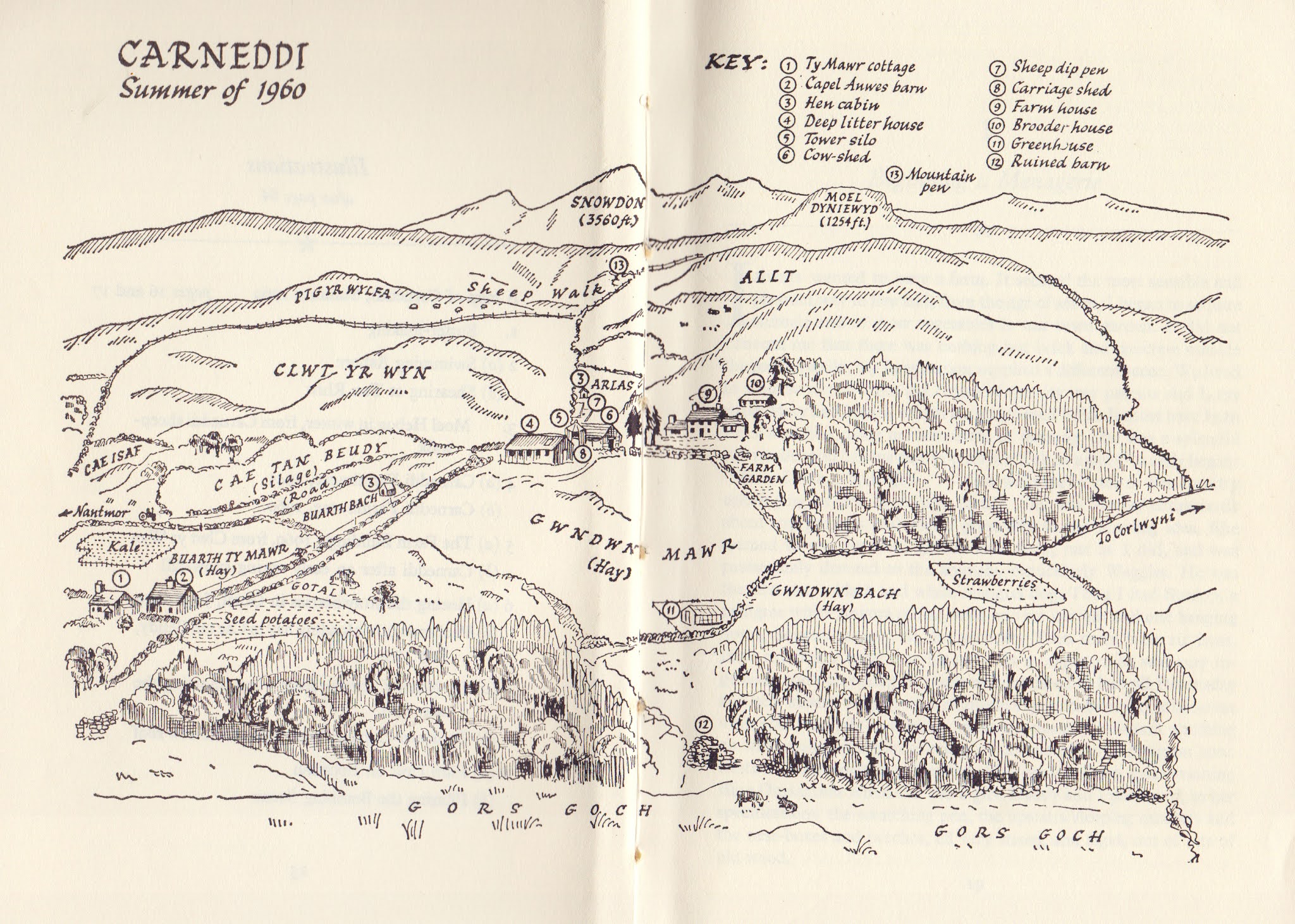
"I have always wanted to have a farm". Ruth Janette Ruck grows up in a town, but likes to keep animals and grows vegetables in the garden. After finishing school she has no idea what she would like to do next, but then she suddenly falls ill with diphtheria and nearly dies. A long recuperation follows, after which she and her parents, sister Mary and nanny Fred (who has been with the family since Ruth was born) take a holiday in Nantmor, North Wales. During the holiday they discover that Carneddi is for sale, a small farm in the hills (83 acres, of which only a fraction can be used).

"I think it was mother  who first suggested that we bought Carneddi. The thread of out normal existence seemed to have been broken by the end of the war, which made my father’s work redundant, and by my sudden illness. A moment of pause and choice had come to us. (…) At first the idea of farming in the hills seemed quite impracticable. My father was fifty, I was seventeen and we had lived in the city all our lives. It was true that Carneddi was to be sold cheaply, but even so we had little money to cover any mistakes we might make. Yet somehow we were unwilling to settle back into a suburban routine once more. We talked, wondered, and at last decided. We bought the farm, and burned the boats of the life we had always known."

They move to the farm in 1946. With the farm they acquire sheep, cows and a sheepdog. Their neighbours (whose first language is Welsh) are very helpful. At first their policy was "to farm as it had been farmed in the past". Ruth reads all she can find on farming and is especially encouraged by The Farming Ladder by George Henderson.
They watch other people’s farming activities with an eager eye, and copy them.


The farm comes with a small mountain flock of sheep and they find a shepherd, Tom, to help them with it. They make improvements to the house and buy a cart horse.

To learn more. Ruth goes to work on a farm but returns when she realizes her family cannot manage without her. To make the business pay they need to farm more intensively. I wonder it Ruth had any idea what „ intensive farming” would come to mean a few decades later . . .
She starts by keeping more chickens and taking part in a government scheme that means she receives food coupons for chicken feed.
The few cows they keep provide them with enough milk for their own use. I presume they grew their own vegetables but no mention is made of this.

Ruth thinks women do not make good employers. "By nature they prefer to follow rather than to lead and the thought of employing a man can be a horrifying one.”  Nevertheless she employs Paul, to help her with improvements, partly subsidized by the Hill Farming Act. 


Paul is an experienced climber and together with friends he and Ruth make many trips into the hills. Although initially apprehensive, she later begins to relish climbing

After 5 years at Carneddi Fred leaves for Australia; Ruth gets the chance to work at George Henderson’s farm.
Back home again she builds a new shed for the chickens. With an asbestos roof!
Later she keeps turkeys. She also joins a successful scheme for growing strawberry plants in isolated place to keep them far away from aphides.
She manages to rent a cottage (Ty Mawr), does it up and rents it to tourists.
The book ends with the story of how Ruth spends summer months working for a film crew, filming The Inn of Sixth Happiness.


In the first chapter Ruth says: „We had little money to cover any mistakes we might make.”
This makes it even harder to understand what the family lived on, especially during the first few years, when sheep die and chickens are killed by foxes. During this time Ruth spends long periods away from the farm (studying and working on another farm) and her parents are not able to manage on their own.
And then there is „nanny” Fred, who, presumably, they pay. They also employ people to work on the farm.

The family start out as amateurs, but Ruth becomes a real farmer. It is interesting to read how you could apparently make a living from such small scale farming in the 40’s and 50’s.
To the 21st century reader, the enthusiastic use of insecticides and asbestos is startling.

I like this book because of the combination of the personal and the practical. It can be read as a handbook for hill farming, but it is also Ruth’s autobiography.
Ruth went on to write two more books, which I will cover in later posts.