Monday, 14 March 2022

A House by the Shore: Twelve Years in the Hebrides, by Alison Johnson, with illustations by Christine Dodd (1986)


Alison and Andrew meet at Oxford and, after finishing their studies, don't want to join the ratrace. What will they do? Andrew is a good handyman and Alison is a good cook. Thinking about their interests, gradually a plan emerges: they will buy a large and derelict old house, near the sea and in the country, restore it and run it as a hotel. For this of course they need money and they decide to become teachers. After a postgraduate course in Aberdeen they find jobs on Harris, where they spend three years teaching, living in a rented house and getting to know the island, the islanders and the weather (which can be vicious). After three years they discover an old and derelict house, a former manse (Scottish term for a dwelling of a minister of the Church), near Scarista Bay, and they manage to buy it. 'We wanted everyone to come and see this miracle. Those who did were inexpressibly shocked". 'The house itself had about 19 rooms, but the six in the attic had insufficient headroom to comply with building regulations, and the two outlying single-storey wings at the front had their internal access blocked up. They and the ground floor of the back wing were the most derelict parts: very derelict indeed."  

First of all they set out to make a few rooms habitable (so they can live there) and to restore the water and electricity supply. They start to keep hens and make first attempts at a vegetable garden. At first they combine doing up the manse with teaching, but it is slow going: 'At this rate it would be ten years till we were finished". They resign in September 1977, a year after buying the manse. Months of hard work follow, repairing the roof, walls, floors, doors, windows, the list seems never ending. 


There are nine months between stopping teaching and opening day, and this is barely enough. Furniture and furnishings have to be bought, mostly on the mainland as very little is available on Harris. 'We were amazed and amused that bookings were coming in at all. Our attempts at publicity had been very haphazard. As we were starting with only four bedrooms we did not need to attract large numbers of customers. (...) Looking back, it is suprising anyone came at all.' On the last day their neighbours help to clean the whole house. 'Next morning we stepped out of our filthy attic into a house unnaturally clean and luxurious." Once the guests start coming the kitchen becomes Alison's domain, while Andrew is 'front of house'. There is still lots to do, doing up the remainder of the house, cleaning and ordering food, supply being a problem as little is available on Harris itself. The hotel is closed in winter giving them time to catch up.

The hotel had brought them self-confidence and a flourishing reputation - even some money. But: 'by the end of the second season, we could see it coming. We had proved to ourselves that we could what we set out to do, and after that we felt aimless, marking time until some new goals surfaced.' They keep going for a good few years though, inventing new projects, like creating a new dining room, building a cottage for the housekeeper and her family, and building a new block with extra rooms. 

The last chapter is called Dropping Out Again? They are looking for something new, but don't know yet what it will be.

On the surface this is a perfectly pleasant book. However, there were several things about it I did not like. Alison and Andrew seem to think teaching a useless activity, so I was glad to read they gave it up. Also, Alison has a way of being self deprecating which irritated me. Its seems everything they do is amateurish, falls to pieces, goes wrong, but then in the next paragraph they are running a successful hotel. And I can't stand people who can't control their dogs and who think that's funny. Alison thinks it is hilarious and devotes a whole chapter to their dog. So, all in all, not one of my favourite books!

As for a new venture, Andrew, Alison and Sarah (their daughter) Johnson now run The White Horse Press.  An interview with Sarah (referring to her childhood on Harris) can be found here.  Scarista House is now run by Tim and Patricia Martin.


Wednesday, 2 March 2022

Living in The Netherlands: Water and Bridges

I would guess that most of my readers live in English speaking countries. So I thought it a nice idea to, every now and then, give you a glimpse into what it is like to live in The Netherlands. First stop: water!

We live in a large (by Dutch standards) town, round the corner from a large canal. There is a bridge we cross often to visit the supermarket and the open air market or to go the metro station. It is a busy canal and the bridge opens at least once every hour to let the ships pass: empty ones on their way back to the locks and the port of Rotterdam, full ones on their way to Delft or inland ports further north. It is with reason that one of the most used excuses for being late at school is: 'de brug was open' (the bridge opened). Here is what the ships look like:

So, we were shocked to hear that a defect had been discovered which made it dangerous to open the bridge, necessitating urgent repairs. Suddenly the bridge stood open permanently, like this:

The small building on the right side of the bridge is the former 'brugwachtershuisje' ('bridgekeeper's house'), now a tiny coffee bar. The bridgekeeper now occupies the new building, just seen on the left of the bridge. From this building he can operate two other bridges as well.

All road traffic had to use other bridges.  For us, it meant about 30 minutes extra walk (though the council did operate a shuttle bus). After a few weeks we heard repairs where going to take longer than expected, and instead of a bus we would get a ferry! 

And here it is (the building above that bridge is also a bridgekeeper's house ). I suppose people in a hurry may dislike it, but we enjoy it. It feels like a tiny holiday every time you board. And also: people talk to each other.

I am sure we will miss it after the bridge is fixed!

Tuesday, 22 February 2022

The Fat of the Land by John Seymour, with illustrations by Sally Seymour (1961, my edition from 1974)


'Here we all sit, Sally my wife, Jane who is five and a half, Ann who is two and a half, and Kate who is seven (days), a mile from a hard road, with no electricity, no gas, no deliveries of anything excepting coal, provided we take at least a ton, and mail, and the post woman gets specially paid for coming here. And we are self-supporting for every kind of food excepting tea, coffee, flour, sugar and salt.'

We all know John Seymour as the godfather of a movement but it seems he stumbled upon his calling. After living on a boat John (who works as a writer) and his wife Sally (who is a potter) start looking for a house for their young family. On page 14 he states: 'Certainly we did not want a farm.' They have a hard time finding a place to live but then they are offered a double cottage in a remote location ('The Broom') for very little rent, provided they keep everything in repair. When they move in they have one daughter, a second one is born while they are living there. 

It is the remoteness that does it. 'For every single thing we wanted we had to go a mile and a half to the village to buy it. Our milk we arranged to have left every morning at some cottages a mile away from us, and every morning somebody had to go and get this.' So they get a cow (in August 1957) to provide them with milk. 'We were forced into pigs by circumstance of having three or four gallons of milk to dispose of every day.' This was when they had not yet learned how to make butter and cheese. 'And what were we going to do with all that dung? We would have to extend our gardening and farming activities. Brownie forced us, a long way, along the road that we had never planned to travel: the road to self-sufficiency and a peasant economy.'


In his biography on the Seymour family website it says: John Seymour roared through life. This is certainly the feeling you get while reading The Fat of the Land. He displays all the zeal of the newly converted, in his hurry to tell the story he often has to stop and say: but that was later, I'm getting ahead of myself.


John and Sally start growing vegetables and acquire chickens and ducks and plant fruit trees.  They are novices at it all: 'We worked ridiculously hard. For not only did we have to do a great number of jobs every day - but we had to learn how to do them. (...) Whether it was planting a fruit tree, sowing some radish seed, wringing a duck's neck, gutting and skinning a rabbit: we practically had to do it with a book in one hand and the thing in the other. This made everything ten times as difficult.'

Learning to mild a cow is hard. 'I have found that there is only one real teacher for difficult things: necessity. I milked Brownie because I had to milk her'.
Though John devotes a chapter to the house (describing the rooms and what they are used for), we get no idea what it was like to live there as a family. After the first few pages the children aren't mentioned in the book.

John and Sally use books at first to find out how to run a smallholding, but a few chapters later John seems to have thrown them out. He does not care for anything"modern" and as for the poor wageslaves who live in modern houses, in villages or towns, they have lost all connection with nature and simply don't realize how badly off they are.

The book is part story, part how-to (it includes an index). John relates all their successes and failures with vegetables, their use of different kinds of wood, the slaughtering of pigs. There is also a large section on thatching and chapters on preserving, wild foods and the use of tools. John also gives an insight into the amount of money they spend and earn (John works as a writer and broadcaster, and Sally sells her pottery).


For transport they first use their old van, and they dig the land by hand. Then they decide to buy a horse. 'A horse will plough, cultivate, harrow, roll, horse-hoe: very much faster than a garden tractor costing a hundred pounds. It will do it silently without drowning the song of the birds. It will do it on grass, which is cheap and does not entail the expenditure of foreign currency. You can ride a horse, and teach your children to ride, and you can make him pull a cart and take you to the pub when you want to go. And bring you back again, which is more important. He knows the way.'


My edition from 1974 ends with an extra chapter in which John looks back on his time in Suffolk and tells us of his move to Wales. 'When we found ourselves becoming self-sufficient in food at the Broom we were probably the only family in England living this way. Now hundreds are doing it - and tens of thousands who would like to. ' The story of his Welsh farm is told in 'I'm a Stranger Here Myself' (1978). 

The Broom is now available for rent as a holiday cottage.

A good source for further reading on John Seymour is his family's website Pantryfields


Wednesday, 16 February 2022

Adrian Bell

A tip from Avis: Slightly Foxed's latest podcast is on Adrian Bell   I will listen to it tonight. All of the podcasts end with recommended reading and I was very pleased to see that one of my favourite books (Acts and Omissions by Catherine Fox) is included.

Friday, 11 February 2022

The Hovel, revisited

Sue, at My Quiet Life in Suffolk, just put up a great post about Elizabeth West's books. It includes photo's from a hardback copy of Hovel in the Hills, and pictures of the "Hovel" in 2005. Enjoy!

Thursday, 27 January 2022

She Took to the Woods by Alice Arlen (2000)


This book contains a biography of and selected writings by Louise Dickinson Rich (1903 - 1991), who is best known for her memoir We Took to the Woods (1942). 

Alice Arlen was able to talk to Louise's children Rufus and Dinah. She also had access to various scrapbooks, diaries and letters . The book includes some very pale and badly printed photo's (or was that just my copy?), which we spruced up a bit after scanning to show them here,

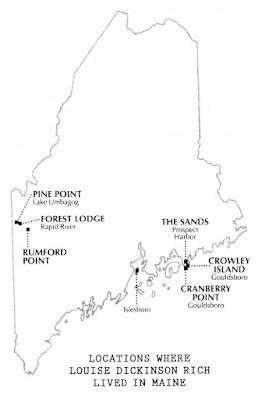
Louise grew up in Bridgewater, Maine, where her parents, intellectuals, Democrats and Christians, owned the local weekly newspaper. I suppose her upbringing can be described as spartan (by today's standards anyway) and happy. At 17, she entered a teachers college, where she began to write. Shortly after starting her first job she met and married John Bacon. The marriage was short-lived and they divorced in 1931, Louise returning to teaching. During a canoe trip in 1933 she met Ralph Rich and she soon joined him at Forest Lodge. This is the periode she described in We Took to the Woods. As this is one of my favourite books I was very interested to read about this time from another point of view. One thing that becomes clear is how very little money Louise and Ralph had in those early years. Writing stories and entering in competitions was done out of sheer necessity: 'Why did I write my first story? ' Louise answered in an interview. 'Desperation, I guess'. This first story (1936) brings in $50. In 1938 they were doing OK, but in September a hurricane struck, partly destroying the house. To quote Alice Arlen: 'They were desperate again'. From Louise's 1938 diary (it is one of those 5-year ones with very little space, hence the short entries) : 'October 24: Snow squalls. Ground white. Food situation acute. Started Gerrish sweater. 25: Warm and lovely. Worked on story. We are practically starving. Don't know what the outcome will be. They kept afloat, but only just, by selling stories. 

Ralph and Louise in the 1930's.
 
 
Louise's luck turned in 1939 when she came to an agreement with New York agent Willis Wing who provided her with a monthly check in exchange for a monthly story. An additional element was the plan for Louise to prepare sample chapters and an outline for a book on her wilderness experiences. After this book, We Took to the Woods, was published things took a turn for the better, with serial rights being picked up, and selection for the Book of the Month Club.


In 1944 things were still going well for Louise and Ralph, with Louise selling stories and earning royalties. But then, on December 18, Ralph suddenly died of a cerebral hemorrhage. In addition to dealing with the loss of her husband, Louise faced debts run up by him. She slowly picked herself up, once again turning to story writing to earn money. Happy the Land (sequel to We Took to the Woods), was published in 1946, My Neck of the Woods in 1950. In total she published 24 books. She always remained in Maine, in Bridgewater where she grew up, and later in several towns on the coast, a region she also grew to love. She spent her final years with her daughter Dinah and died in 1991, aged 88. Her ashes were scattered at Forest Lodge.


Monday, 17 January 2022

Apple Acre by Adrian Bell (1942)

My edition is from 1964, with a new foreword and epilogue by the author. Illustrations by Richard Kennedy.

Apple Acre is the story of farming and bringing up young children in the dark days at the beginning of the Second World War. " I had come to this village of Gruncham from West Suffolk just before the Nazi War. I had a few acres there, and later in 1943, I acquired more. Our children were infants when the war started, Anthea was three, the twins (Martin and Sylvia) were only one. We were five miles from the nearest town, and had no car nor petrol to get there. There was a bus twice a week. Otherwise we relied on bicycles or a pony trap for our shoppings. We seldom left the village in those years. There were shortages of the necessities of life - of clothes, food, milk, eggs. We were lucky in having our own pig, our own hens. Our staple food was potatoes and bacon. My wife made all the children's clothes from old garment of hers or a store of material we had laid in in August 1939. We had no piped water. Our well ran dry regularly every summer: unless it rained we could not have baths."

This is the story of Adrian's farm, the landscape, the farmers,  craftsmen and other people in the village. Or rather, it is not so much a story as a collection of Adrian's thoughts and observations. After reading the book you don't actually know much about his farm, but you do know what it felt like to live there at the beginning of the war. Adrian needs few words to paint a picture.

One day he and his wife Nora buy six goslings who turn out to be voracious creatures. "We referred to a book and read: "Goslings require very little artificial food, as they consume large quantities of grass." I wished these goslings could read.  And then one day towards Michaelmas, they happened to be at the far side of the orchard when I went out with their food. They stretched their necks and came full pelt - full waddle, that is - their wings flapping. Suddenly the leading goose became airborne and then the others. Their feet continued paddling the air. My impression was that they were as surprised as I was to find themselves flying. They gathered momentum, overshot the food, gave one despairing honk at it, and sailed out of sight over the hedge." The geese return to the farmer who sold them to Adrian ...

At first the war hardly seems to intrude and life goes on like it always did. The children seem to take the noises they hear (guns and planes) for granted: "It's only an aeroplane," Anthea says, as we look up and see one of England's battle planes sailing over at two or three hundred miles an hour, and she stoops again to make another sand pie. Aeroplanes are not very interesting birds, Anthea thinks. Not as interesting as the blackbird sitting on five eggs in the hedge." But later the threat of invasion becomes more real and Nora and the children spend a year in northern England.

"The war is more than bombs, it is a state of being. I feel it in the furtive quiet of the town. It is the soul of civilization that has fallen, caved in, long-decayed, hollow: and everybody goes furtively, knowing the end has come."

I especially like this book because of the way Adrian Bell writes about his children. He has an eye for their behaviour, an ear for their talk.


"Martin has seen the big mirror. Nora is left playing nursery rhymes to herself. Mirror superseeds music. Martin is stood up in front of it. He looks first at us in the mirror. They are here, yet they are there: what is the solution? His eyes get wider and blacker. Sylvia is held up to it. She quickly takes it for granted that there should be two of everybody. Anyhow, she is not going to worry about it. Grandma swings her to her reflection: she laughs uproariously. Martin is not amused. To be waved at in the mirror makes it the more puzzling. He struts around the room very worriedlooking."


"Filling being put into a new cake. Anthea has got on to a chair to see. 'I want a piece'. Occasionally she tries something quite obviously unpermissible. 'I want a piece now.' 'Whoever heard of such a thing!' It has worked: she begins to chuckle: 'I want a piece now.' Taking off my boots, feeling warm and cheerful beside the chrysanthemums, I begin, 'Do you know, when Father was a little boy - '  That always makes Anthea look. 'Yes?' 'When Father was a little boy he always had to have two slices of bread and butter before he was allowed to have a piece of cake.' 'Yes. And did your mummy make you a chocolate cake, with fillin' in it?' 'No, it was just a plain sponge cake: (I do remember a lot of plain sponge cake) and no filling in it.' 'Yes." A small voice. I look up sharply. The head is lowered, the face red. The thought of Father getting only plain sponge after the dutiful two slices is almost too much. I hasten to add, 'But if he had been a good boy he used to have a chocolate biscuit sometimes." Yes." A whisper. 'But then', crescendo, 'when it was his birthday he used to have a lovely cake, all sugar icing, and Happy Returns of the Day written in pink, and candles -' 'Yes' The head higher. 'And he used to have lots of little boyes to tea with him, and they played all sorts of games.' A smile. 'Why, look at pussy - she's trying to catch her tail.' She is having a whirling fit on the floor. Relief and joy."

Much has been written about Adrian Bell, there is an Adrian Bell Society , but this book seems to be less well known.

The back flap of my 1964 reprint gives an interesting glimpse into how men and women were thought of at that time: The children of whom he writes in Apple Acre have now grown up. Anthea and Sylvia are married and have young children of their own, while Martin is a journalist. Quite.

Anthea became an eminent translator , perhaps best known for her translations of the Asterix comics.

Sunday, 26 December 2021

Christmas in The Netherlands, 2021

For years we didn't bother getting a Christmas tree, but when I saw this one, made of branches and string I could not resist it. Like last year, we hung it on the wall before Sinterklaas (Saint Nicholas eve, 5 december), really a faux pas, but since corona has entered our lives that seems to be what most people are doing. We enjoy decorating it, and cards and ribbons, and whatever else comes in,  are added as December progresses.


Hope you all have a wonderful time!

Christmas in The Netherlands, 1944

" Monday, 25 December. Christmas if fortunately behind us. It was a day full of good things. This morning by the Christmas tree I again read the Christmas story to the children. Then came four Germans who wanted to billet themselves, but it was too small for them. Then we sang Christmas carols with piano accompaniment until 5 anti-aircraft guns came rattling by on the road. Then we went out. It's clear and freezing - bitterly cold - and we put on many layers of clothing to save our calories.

Moeder had come to drink a cup of coffee and then walked with us until we were at the family Jos' house, which was our destination. At 1: 00 we had dinner (meat! and canned peas and rice pudding made with half milk and half water!) and at 3: 00 we went with the four of us to Stameren to visit Annetje and Floris, where we got real tea with white bread - pinched from the Germans - to serve instead of cake! By moonlight home through the snowy woods. Then I really missed you! And now with all our clothes on we go under the blankets."


From: This Faithful Book by Madzy Brender à Brandis

Wednesday, 22 December 2021

Christmas in the Woods

"Christmas in the woods is much better than Christmas on the Outside. We do exactly what we want to do about it, not what we have to do because the neighbours will think it's funny if we don't; or because of the kids, who will judge our efforts not by their own standards but by the standards set up by the parents of other kids. We don't have any synthetic pre-Christmas build-up, no window displays, no carol singers in department stores, no competetion in the matter of lighting effects over front doors. At the intersections where the deer-runs cross the Carry Road, no Santa Clauses ring bells in the interest of charity. We didn't even have a Santa Claus until last year. We thought it would be nice if Rufus grew up knowing who gave him presents and bestowing his gratitude in the proper places. So we had never mentioned the name of You-know-who. However, a visitor at Millers let him in on the secret, explaining to him that Santa Claus is the man who brings things for little boys. Rufus knew very well that Larry Parsons brings in everything we get from Outside. Q.E.D., Larry is Santa Claus. He still persists in this belief, which makes him perfectly happy and we hope it does Larry, too."

From We Took to the Woods, by Louise Dickinson Rich


Sunday, 12 December 2021

Land for our Sons (1958) and This Faithful Book (2019) by Maxine Brandis / Madzy Brender à Brandis


This was a tip from Clarien, who blogs here (in Dutch) on her smallholding. Looking up information on the book and the author made me curious so I ordered it, plus her World War Two diary This Faithful Book. 

First of all a note on names: the author, Mattha van Vollenhoven (always called Madzy) was married to Wim Brender à Brandis (this name is not as unusual as I thought, I found extensive family trees on the Internet). In Canada she wrote under the name Maxine Brandis. Her daughter, a writer who edited the diary, also uses the name Brandis, but chose to use her mother's full name for that book. Madzy's sons (more on them later) use the full name.

Maxine and her family (she and her husband have a daughter and two sons) emigrate to Canada in 1947. They travel to Terrace, British Columbia, where they stay with friends. Soon they are able to buy a small farm. They keep goats and chickens, and grow vegetables and fruit, which they sell. The house on the farm, which is very small (at first the whole family sleeps in one room), is gradually extended. Although they have chosen a location with a very short growing season (June to September) they are successful. At first the town where they live is very isolated (three trains a week) and there is no hospital or dentist.

Maxine makes a strong point for immigrants to learn the language and to adapt to the new country. However, sometimes she herself has trouble adapting, like on the occasion when a young child calls her by her first name. She is shocked: "in the Netherlands they would call me aunt Maxine!" She then gives us a glimpse of her strict upbringing in an upperclass family, where she had to address her father with the formal "U" instead of the informal "je". Like French and German, Dutch has two forms of address. I can relate to her shock. I can still recall my discomfort when, staying with my sister in Australia in 1970, I was expected to call people aged 70 and over by their first name. At home we just did not do that. 


The farm prospers, and the children do well, with Maxine becoming manager of the district's cooperative society, but after a while Maxine's husband feels he should return to university (after having spent a few years there in the Netherlands) as having a degree will give him more chances. So they sell the farm.

I'm afraid I was slightly underwhelmed by the book. It is not so much a story as a series of vignettes, in which everything goes well, everyone is friendly and hardly anything goes wrong. At times it felt like an ad for emigrating to Canada. I thought the title odd as Maxine has a daughter and two sons, and the family had no plans to continue farming.

This Faithful Book was published in 2019. It is the diary Madzy kept from 1942 till the end of the war. The diary was translated and edited by her daughter Marianne. In 1942, Madzy and her husband Wim, who had been an officer in the Dutch army, are living in a small, isolated, house in the middle of the Netherlands with their small daughter Marianne (nicknamed Pankie). Wim has to report to the occupying German authorities once a month. In August 1942, two days after Madzy has given birth to their son Gerard Wim and his fellow officers are arrested without warning and sent to P.O.W. camps in Poland. He will not return until 1945. Madzy starts keeping the diary as a kind of letter to Wim, for him to read after his return.

I enjoy reading about ordinary, day-to-day life in those exceptional circumstances. This book was especially interesting to me as my parents lived nearby and also had two young children. I was once again struck by the hardship suffered by people in the last year of the war. Maxine was lucky to have people staying with her to help (mostly her old nanny, still employed by her mother), but it fell to her  to find enough food for the family, especially hard in that last extremely cold "Hunger Winter", when they sometimes had nothing more to eat than a few slices of bread or some potatoes There was no electricity, very little fuel and they lived close to a railway line that is often bombed. On top of that she has to find room for evacuees and Germans who demand a billet. I'm also sometimes amazed at the things that did still work, like delivery of letters, even from Wim in his prison camp in the Ukraine.

Sunday, 21 January. It was exceptionally beautiful in the be-snowed woods and even though we constantly heard heavy artillery fire in the distance, and now and then the bang of a V-1 or V-2, it was still beautiful, almost in a holy way. I've now wrapped each of the children in a blanket in a little nest, with a fur coat around their feet. It's terribly cold in the bedroom."

"Tuesday, 30 January 1945. Today we heard all of a sudden that we have to make do with our bread ration for two weeks instead of one. This means that we have 500 grams per person per week, Gerard 400 grams."

"Wednesday 2 May, But who can describe how overwhelmed we were when, just after that, five of those huge birds (airplanes bringing food) flew right over our little house? We screamed, waved, jumped, cried - what all didn't we do? The emotion was indescribable; it is as though a little window opens and one can again see a house of peace."

During the last months of the war they are often in the firing line, and many houses in the village are destroyed. After the German surrender Madzy still has to wait and hope for Wim to come home. In the end he returns on the 5th of June. In one of the final chapters Wim tells the story of his years in captivity.


In a postscript daughter Mariane writes: "Madzy had intended to give the diary to Wim when he returned, but she never did; he only read it after her death. It's easy to guess why she made that decision. (...) Very probably she felt that he (Wim) should not be exposed to the grimness of some of what she had written in the diary, that the best way to heal would be to look forward rather than back. Before post-traumatic stress disorder became more widely understood, this was what one did." Marianne then tells the story of the rest of Madzy's life. On emigrating to Canada she says:" It's hard for us in this time to imagine how little Wim and Madzy knew about their destination. Other than (as it turned out) misleading and romanticized information from Peter and Enid, they knew virtually nothing because there were no sources of information." Life on the farm in Terrace seems to have been more primitive than Madzy would have us believe in her story in Land for our Sons. After a visit in 1952 her mother reported to people in the Netherlands that her daughter was living in a "hut."

Madzy died in 1984. Her three children have all had interesting careers: Marianne became a historian and writer, find information on her here. Gerard became a wood engraver and maker of books, his website is here. Her third son Joost, born after the war, is known as Jock in Canada. He is a social entepeneur and inventor. An interesting article about him can be found here

I can recommend this book if you would like to know more about life in an occupied country during World War II. There are two other titles which I loved and which might be of interest to English readers: I Was a Stranger by Sir John Hacket, republished by Slightly Foxed , the story of General Hacket's escape from hospital during the battle of Arnhem and his stay with the sisters De Nooij in Ede. Because I grew up in a neighbouring village I knew that story long before I read the book. I also recommend The Cut Out Girl by Bart van Es, published by Penguin, a story of a young Jewish girl in Holland during World War II, who hides from the Nazis in the homes of an underground network of foster families, one of them the author's grandparents. Part of this story takes place in the village where I was born.

Sunday, 28 November 2021

A Patch in the Forest by Elisabeth West (2001)


I bought this book years ago, but it is now out of print and second hand copies sell for 50 to 60 Euro's. The book has a few illustrations and no maps.


When Elizabeth West finished Garden in the Hills  she and Alan were preparing to leave their Hovel in the Hills because there was no way they could make a living there. Also they found that new roads and increased traffic meant they could no longer live there in peace. "We promised ourselves that one day, as soon as we were entitled to a state old-age pension, we would find another patch of land in a wild and lonely place and make another garden." In the early 90's, when they are both receiving pensions, the time has come to find a new place to live.

"Now that the time to make our plans had arrived we found that the passing years had modified our ideas. With old age ahead we didn't want our patch to be wild and lonely, nor did we reckon on coping with more than an acre of land. A place on the outskirts of a village or hamlet would be ideal - preferably on a no-through road and within a half-mile walk of a post office and bus service". After an 18 month search they buy a small house in the Forest of Dean. It has a garden with an enormous oak tree in it.


In 1993 they move in. The house was built in the early 1960's. Everywhere they look they find "workmanship of such incompetence that we almost begin to suspect malicious intent." So Alan does a lot of repairs. They create a kitchen and "back kitchen", remove some of the 24 doors, and rip out all the complicated water pipes and central heating, and "start again". They install an Aga in the kitchen, have an open fire in the living room and use electric heaters, when needed, in other rooms. They are allowed to gather brushwood in the forest and also buy locally dug coal.

The garden is about half an acre (on a slope). It does not get much direct sunlight, suffers from mists and frost and has bad soil (clay mixed with rubbish to level the site). Nevertheless they manage to create a beautiful garden there.  Their aim is to attract as much wildlife as possible. Part of the garden they leave "rough", part is a meadow (mown 3 or 4 times a year), there is a vegetable garden and a pond close to the house, with the rest of the garden given over to "flowers, shrubs and interesting plants." Strangely enough these include Japanese knotweed: "which we like, in spite of what the experts say." (Japanese knotweed is considered to be one of the most invasive species, which can displace many native plants).

Elizabeth describes all the vegetables they grow, stressing "this is how we do it and not suggesting how you should." They can be largely self-sufficient for most of the summer and autumn, but in winter they need the greengrocer. They grow (and dry) a lot of herbs, eat some weeds (like dandelion and chickweed), gather mushrooms and nuts.

Elizabeth and Alan clearly revel in living close to nature as becomes clear in the chapters on their observations of and encounters with birds, butterflies and other animals of the forest.


"Looking out for the birds that visit the garden is, of course, a non-stop activity in this household. We chat to them if they approach us and we mutter greetings if they are about their business in the hedge. If they are flying across the sky or soaring overhead we watch in silent admiration. This looking-out-for-the-birds activity continues even when the weather keeps us indoors, which means we spend a lot of time gazing from the windows."

"Our concern that butterflies should have food and appropiate facilities to carry out their complicated life cycles means that flowers are left to bloom for as long as they are useful and that plenty of rough grass, nettles and bramble thickets are available. We have noticed that chives are usually the earliest vegetable plants to bloom and they are very attractive to bees and butterlies. If we want to have plenty of chive leaves to eat we should really trim off the flower stalks, but we don't. The only answer is to have more chives."

Animals in the forest around them include deer, badgers, adders and squirrels. Elizabeth writes of the plans to introduce pine martens (a natural enemy to the grey squirrel) to the Forest, fearing it will mean a diminishing bird population (note: in 2019 18 pine martens were released in the Forest of Dean). Bats, frogs, toads and hedgehogs visit their garden.

"This invitation to our garden does not extend to that most ubiquitous Forest of Dean animal, the wandering sheep. " (...) "The men who own these sheep belong to a Commoner's Association through which they defend their rights to run sheep in the forest." Attempts to regulate grazing by sheep are not very successful (this still seems to be an issue today).

Elizabeth and Alan don't get many visitors, nor do they go away often. "Having spent most of our working lives engaged in various forms of humble employment (in between periods of unemployment) the need to earn a living had always occupied a lot of our time, thoughts and energies. But we no longer have to work for money, and the sense of freedom in exhilarating." They enjoy their own company, spending time in the garden, listening to music and reading. Elizabeth has become a fan of the bands and choirs in the Forest. And of course they often go for walks.

This book is a must for everyone who has enjoyed Hovel in the Hills and Garden in the Hills. Here's hoping Logastan Press will reprint!


Wednesday, 10 November 2021

We Took to the Woods by Louise Dickinson Rich (1942)


Who can resist a book with a cover like this?


Louise Dickinson Rich took to the woods during the 1930’s and wrote this book to answer the many questions her friends were always asking her.
During most of my adolescence  (…) I said, when asked what I was going to do with my life, that I was going to live alone in a cabin in the Maine woods and write.
She did end up in a cabin in Maine (though not on her own), but completely by accident: on a canoeing trip she met Ralph Rich who had recently moved  there.  Shortly after they were married. And so she moved to the Northwestern-most corner of Maine (with a resident population of about a dozen) where there are few roads and where the lakes are the main thoroughfares. This means that every autumn and spring they are cut off from the rest of the world for a few weeks. During the „fall freeze up” the ice is not yet strong enough to walk or drive on, during the „spring break up” the ice is too thin but boats can’t be used yet. During winter the place is hard to reach too, so all in all, except for summer when the visitors come, they live pretty isolated lives. And that's how Louise likes it. "Emily Dickinson once said of a little niece who had been shut up in a closet as punishment, and was discovered there hours later, perfectly composed and happy, "But no one could ever punish a Dickinson by shutting her up alone!" That applied to Emily herself. And it applies to this obscure Dickinson. It applies to my ability to be contented here, away from the world, and to the truth underlying Ralph's and my relationship: that being with Ralph is just exactly as good as being alone. Now that's written, it looks terrible; and I meant it to be the nicest thing I could say!


Like Helen Hoover, Louise has a Winter and a Summer House, plus various sheds and an outhouse, as there is no plumbing. Gerrish, the „hired help” works for them, he has his own house.
I would imagine that Louise writes the way she talks, so explaining what it is like to live in the woods means lots of stories: on being an official Maine Guide (Ralph), how Louise disliked school, on deer hunting, on searching for deer hunters lost in the woods, cutting ice, visiting lumberjacks, fire wardens and the annual log drive. Early in the book Louise mentions that Ralph had sold some patent rights before he came to live at Forest Lodge, so I assume he had some kind of income. Apart from that they make a living doing all kinds of work: transporting people and goods, taking in boarders, repairing the road, cooking, knitting, car trading (Ralph’s speciality) and writing.
Louise relishes living where she does and does not miss „outside”. She especially does not miss having to bother about clothes and gives us a list of her wardrobe:


I was interested in the prices Louise mentions:  adjusted for inflation, $1.00 in 1942 is equal to $16.80 in 2021.


As we learned from Helen Hoover’s book living in the woods is hard work, and the line between work and spare time is blurred. There is always something to do, like tending the vegetable garden, painting the boats or tapping trees for maple syrup. From November to January they cut wood (after the leaves fall, before the snow gets too deep). Then there is the problem of having enough supplies, as they never know when the "freeze up" will be. Every once in a while they are caught out and Louise will have to make something out of almost nothing in her kitchen.
Unlike the Hoovers Louise and Ralph seem to be completely at ease with and accepted by the people around them. They don’t believe in making wild animals pets, nor do they feed them in winter like the Hoovers did. Only one animal becomes their pet, by accident : ons day Ralph brings home an orphaned baby skunk. This animal becomes an unlikely but much loved pet named Rollo. Rollo is "raised" by Cookie, their dog, who had puppies at the time. When Rollo becomes angry he stamps his feet, but he only once makes a smell when he thinks the cat is stealing his food (the cat escapes and never returns).


The one thing that frightens them is the danger of a forest fire. They know exactly what they will take and where they will go if they have to evacuate. They are never sick („ we are living in a sort of reverse quarantine, which the germs locked out instead of in”). This is just as well, as they have no easy access to a doctor or a hospital. And just as well that baby Rufus arrives without incident. Louise, who had planned to go to hospital to have her baby, gives birth a few weeks early.  Her son Rufus was born with only Ralph in attendance on the 18th of December at 2.55 a.m. with the thermometer down to 10° F above zero (minus 12° C). To make things worse they were still in the (hard to heat) Summer House, Ralph having planned to move things to the Winter House while Louise was in hospital
I can see him now, with a wool cap pulled over his ears, his mackinaw collar turned up to meet it, and his mittens on, reading by lantern light a little book called „If Baby Comes Ahead of Doctor”. Perspiration was running down his face. You see, he knew the doctor couldn’t possibly get there for ten hours or more.” To quell Ralph’s nerves she gives him things to do, like heat lots of water (though she had no idea what for). Then he heats up a blanket and places it in the laundry basket. „ When he came back, five minutes later, he was a father”. 


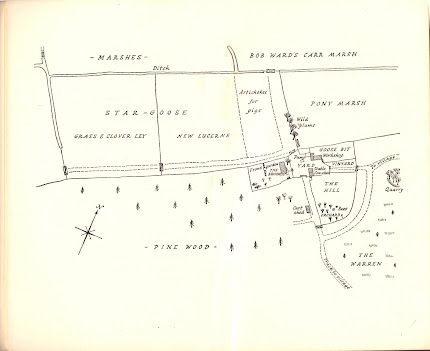
We Took to the Woods is one of my favourites, not least because of the wonderful map. Sometimes Louise is a little long-winded. It made me wonder is any editor was involved or if the manuscript was just accepted as it was. Then again, it makes you feel Louise is just chatting to you. 

Louise went on to write many more books. I have ordered her biography and I will return to her in future posts.